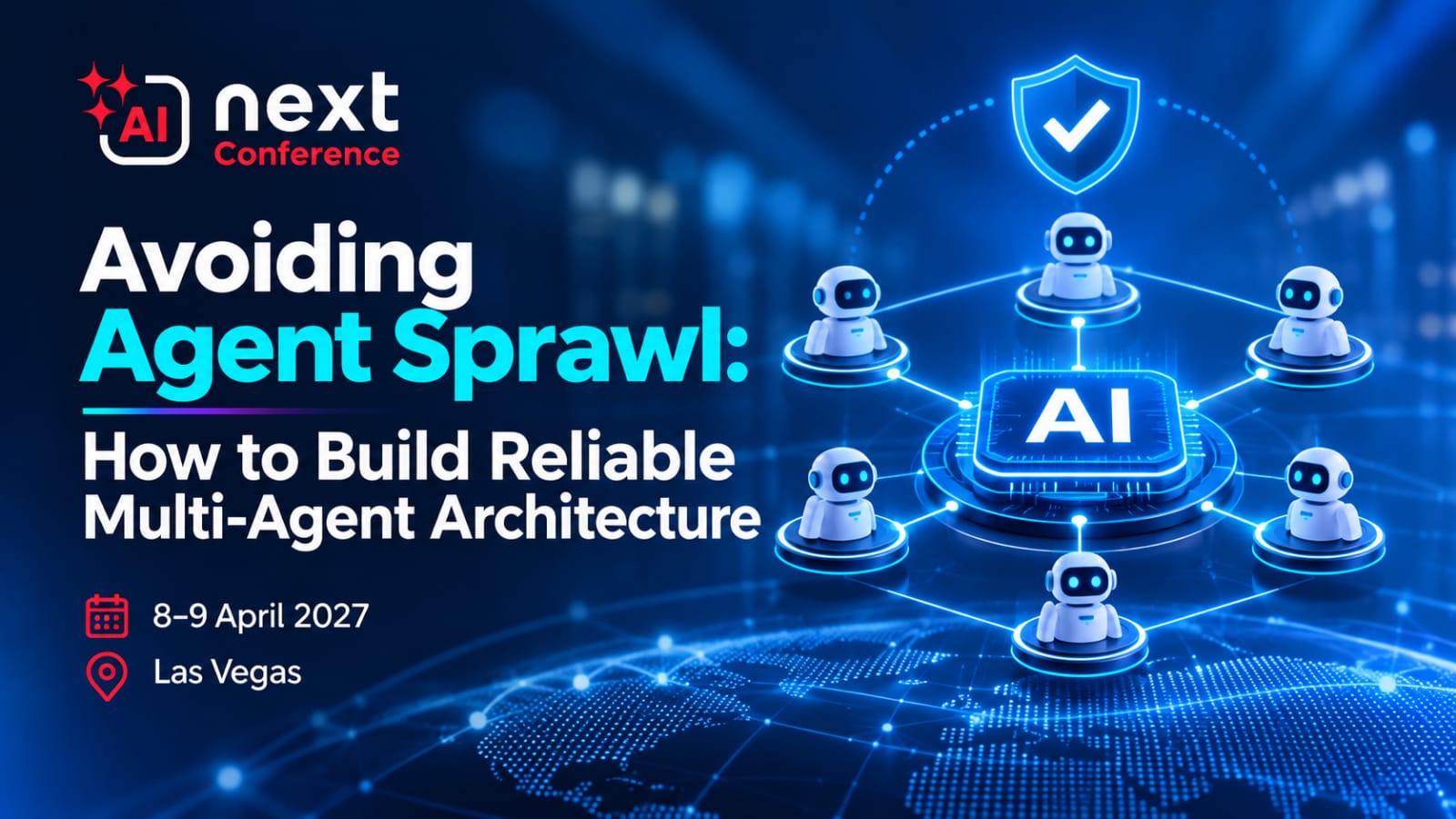
Over the past year, enterprises have raced to deploy autonomous AI agents across sales, customer support, and engineering. Early pilots delivered quick wins, but many organizations now face a familiar roadblock: agent sprawl.
Departments often build isolated agents using disconnected frameworks. The result is duplicated tools, fragmented context, runaway agent-to-agent loops, rising cloud costs, and weak governance. Without unified guardrails, a single hallucination can cascade across multiple automated systems.
Moving from experimental bots to production-grade enterprise AI requires intentional multi-agent architecture.
Here are five strategies engineering leaders can use to control agent sprawl and build scalable enterprise AI systems.
Establish a Centralized Orchestration Layer
Rather than allowing dozens of agents to communicate randomly, introduce a clear orchestration pattern. A supervisor or routing agent should act as the traffic controller: interpreting complex requests, breaking them into subtasks, and assigning work to specialized agents.
Centralized coordination prevents redundant execution, reduces infinite reasoning loops, and gives engineering teams one place to manage workflow logic, retries, escalation paths, and business rules.
Recent Google Research findings also highlight that centralized coordination can improve performance and limit error propagation in multi-agent systems, although the best architecture depends on the task.
Standardize Memory and Context Protocols
Agents are only as reliable as the data they share. When every team builds custom integrations, agents can operate on conflicting versions of the truth.
Standardize how agents access enterprise knowledge through unified retrieval pipelines, shared state management, and consistent data models. Open interoperability standards can ensure that when a customer-support agent updates a ticket, billing and fulfillment agents immediately see the same context.
Enforce Strict Permission Boundaries and Guardrails
Reliability depends on containment. Treat every AI agent like a junior employee with least-privilege access.
Define exactly which tools each agent can call, what data it can read, and which actions require human approval. Deterministic guardrails—such as schema validation, action allowlists, rate limits, and token budgets—stop errors before they reach customers or corrupt production systems.
Design for Human Oversight and Recovery
No multi-agent system should operate without clear escalation and recovery paths. Define which decisions agents can make autonomously, which require human approval, and how the system should respond when an agent fails, produces low-confidence output, or enters an unexpected loop.
Build rollback mechanisms, audit trails, and human review workflows into the architecture. For high-impact actions—such as issuing refunds, changing customer records, deploying code, or making financial transactions—require explicit approval and maintain records of decision summaries, tools used, actions taken, and final outcomes.
This approach strengthens trust, supports compliance, and ensures accountability as AI autonomy increases.
Prioritize End-to-End Observability
You cannot govern what you cannot see. Traditional software monitoring is not enough for non-deterministic AI workflows.
Reliable multi-agent systems require tracing that logs every prompt, tool call, handoff, output, latency spike, and failure across the entire chain. Real-time observability helps teams detect accuracy degradation, audit decisions for compliance, debug failures, and optimize compute spend before costs spiral.
Build the Future of Production AI at AINext Las Vegas
Solving agent sprawl is one of the defining engineering challenges of 2027. As organizations move from standalone copilots to coordinated human-agent teams, sharing proven architectural blueprints has never been more important.
Join AI builders, enterprise architects, and technology leaders at the AINext Awards & Conference Las Vegas on April 8–9, 2027, at the JW Marriott Las Vegas Resort & Spa. Explore deep-dive technical sessions, live demos, and candid discussions on scaling autonomous agents, digital trust, and production AI infrastructure.
Register today and help shape the future of reliable, enterprise-grade AI.