
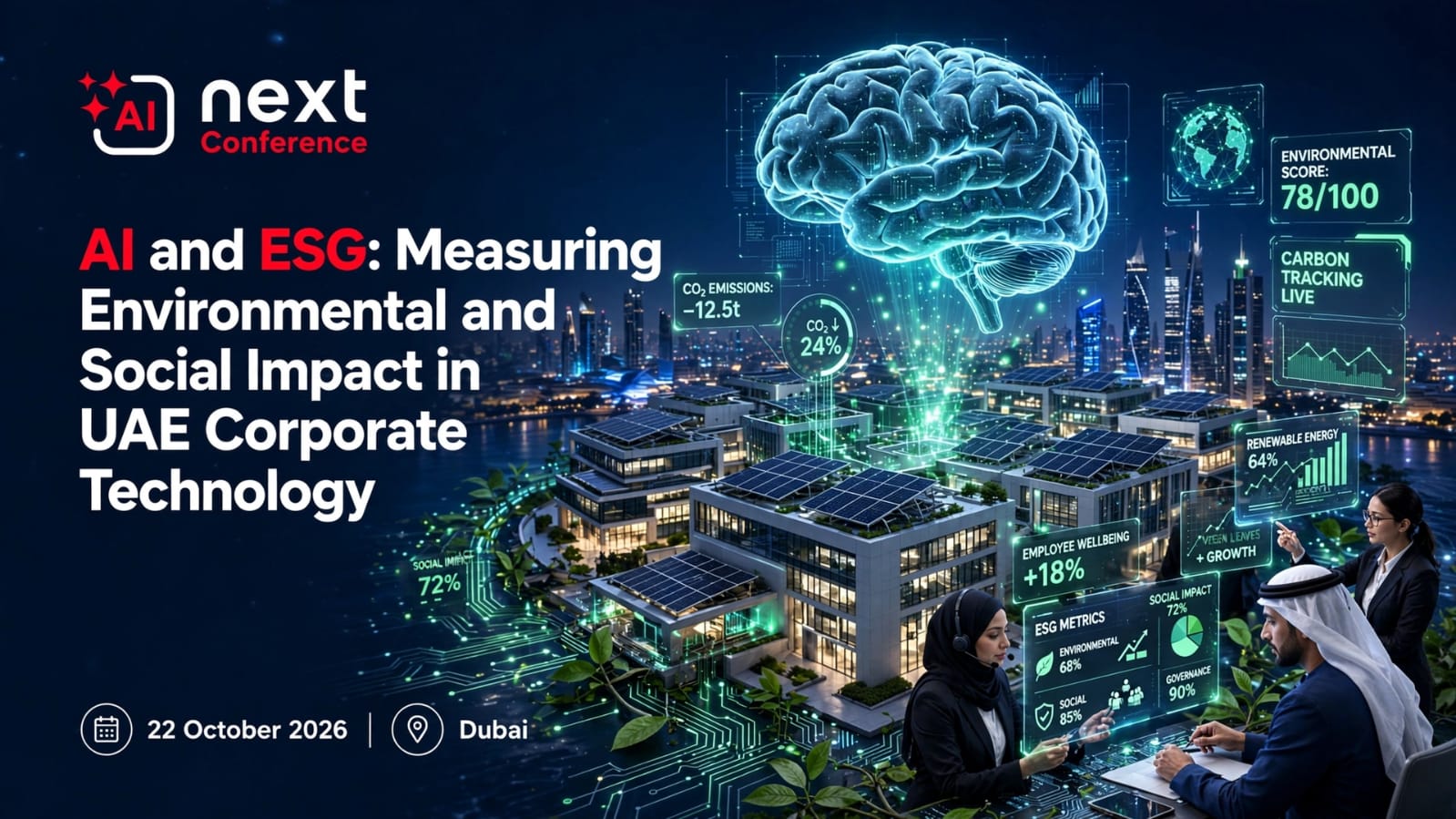
AI is becoming a core driver of business growth in the UAE—but its expansion is also increasing demand for computing power, electricity, cooling and data-center capacity. As organizations scale AI across operations, products and services, corporate technology leaders face a new strategic test: can they capture AI’s business value while managing its environmental and social impact?
This is where green AI becomes relevant. In the UAE, responsible AI, clean-energy transition and sustainable economic growth are increasingly connected. Organizations must therefore evaluate AI not only by what it can achieve, but also by how efficiently it uses energy and resources, how it affects people, and how clearly those impacts can be measured and governed.
The goal is not to slow AI adoption. It is to build AI systems that deliver measurable business value while supporting the UAE’s wider ESG priorities.
Green AI in the UAE: From Energy Challenge to Strategic Advantage.
AI workloads are energy-intensive by design. As AI adoption accelerates, the environmental footprint of the data centers and computing infrastructure that power these systems is becoming a strategic business concern. Globally, data centers are estimated to account for around 286 MtCO₂ in 2025, with electricity-related emissions (Scope 2) representing approximately 76% of the total footprint.
The challenge is particularly relevant in the UAE, where data-center capacity is expanding alongside demand for cloud computing, hyperscale infrastructure and AI services. Data centers consumed around 3 TWh of electricity in 2025, equivalent to roughly 2% of national electricity demand, while continued expansion is expected to push consumption significantly higher in the coming years.
At the same time, the UAE is pursuing an ambitious clean-energy transition, with the country’s clean-energy target raised to 35% by 2030–2031.(WAM)
Federal Decree-Law No. (11) of 2024 on the Reduction of Climate Change Effects further strengthens the regulatory direction around climate action and emissions management.
For corporate technology leaders, this changes the way AI investments need to be evaluated. Every major AI initiative increasingly carries two performance questions: how effectively does it deliver business value, and how efficiently does it use energy and resources?
A four-step playbook for green AI
1. Measure the footprint
Create an AI energy and emissions baseline across training, inference, data pipelines and supporting infrastructure.
Track electricity consumption and associated Scope 2 emissions across AI training, inference, data pipelines and supporting infrastructure. Where material, assess Scope 3 emissions linked to the manufacture, transport and disposal of hardware and data-center equipment.
Monitor practical indicators such as:
•Energy per inference.
•Carbon intensity per workload.
•Power Usage Effectiveness.
•Water Usage Effectiveness.
•Total AI-related electricity consumption.
2. Reduce resource use
Set efficiency targets for major AI workloads. Prioritize smaller task-specific models, model distillation, efficient inference and workload scheduling. Shift workloads to lower-carbon electricity where possible and improve cooling and data-center utilization.
A useful decision rule is: use the least computing, energy and infrastructure required to achieve the desired business outcome.
3. Assign ownership
Add green AI to the organization’s existing technology and ESG governance processes. Require major AI business cases to assess:
•Expected business value.
•Energy and emissions impact.
•Data and infrastructure requirements.
•Social and ethical risks.
•Mitigation measures and accountable owners.
A cross-functional group involving technology, sustainability, risk and legal teams can review high-impact deployments.
4. Prove the results
Define a small set of AI sustainability metrics and report progress against a baseline. Focus on measurable outcomes, such as reduced energy per inference, lower workload emissions, improved data-center utilization or increased use of renewable electricity.
AI tools can support data collection from cloud platforms, IT systems and facilities, but reported figures should be validated and supported by audit trails. UAE climate rules require in-scope entities to measure emissions, maintain inventories, submit periodic reports and retain relevant records for five years.
The social side of AI-driven ESG
Green AI is not only about energy and emissions. The social dimension matters equally. UAE organizations should consider workforce reskilling, AI-related training, diversity, access to technology and the outcomes of AI applications in areas such as healthcare, education, mobility and public services.
Ethical safeguards should also be tracked, including incidents involving bias, privacy or misuse and the measures taken to prevent and address them.
From responsible AI to practical action
The question is no longer whether AI can coexist with ESG objectives, but how effectively organizations can build responsible and efficient AI into everyday operations. For CTOs, CIOs and sustainability leaders, the path is clear: measure AI’s footprint, reduce resource use, assign clear ownership and report environmental and social outcomes.
These priorities will become increasingly important as businesses move from AI experimentation to large-scale deployment. AINext Awards and Conference Dubai, taking place on 22 October 2026 at Crowne Plaza Dubai – Deira, will bring together AI leaders, technology professionals and innovators to examine the technologies, strategies and opportunities shaping the next phase of AI adoption in the region.
For organizations looking to turn responsible AI principles into practical business strategies, AINext Dubai provides an opportunity to connect with the wider AI ecosystem and explore how AI can deliver measurable value while supporting sustainability, governance and long-term resilience.