
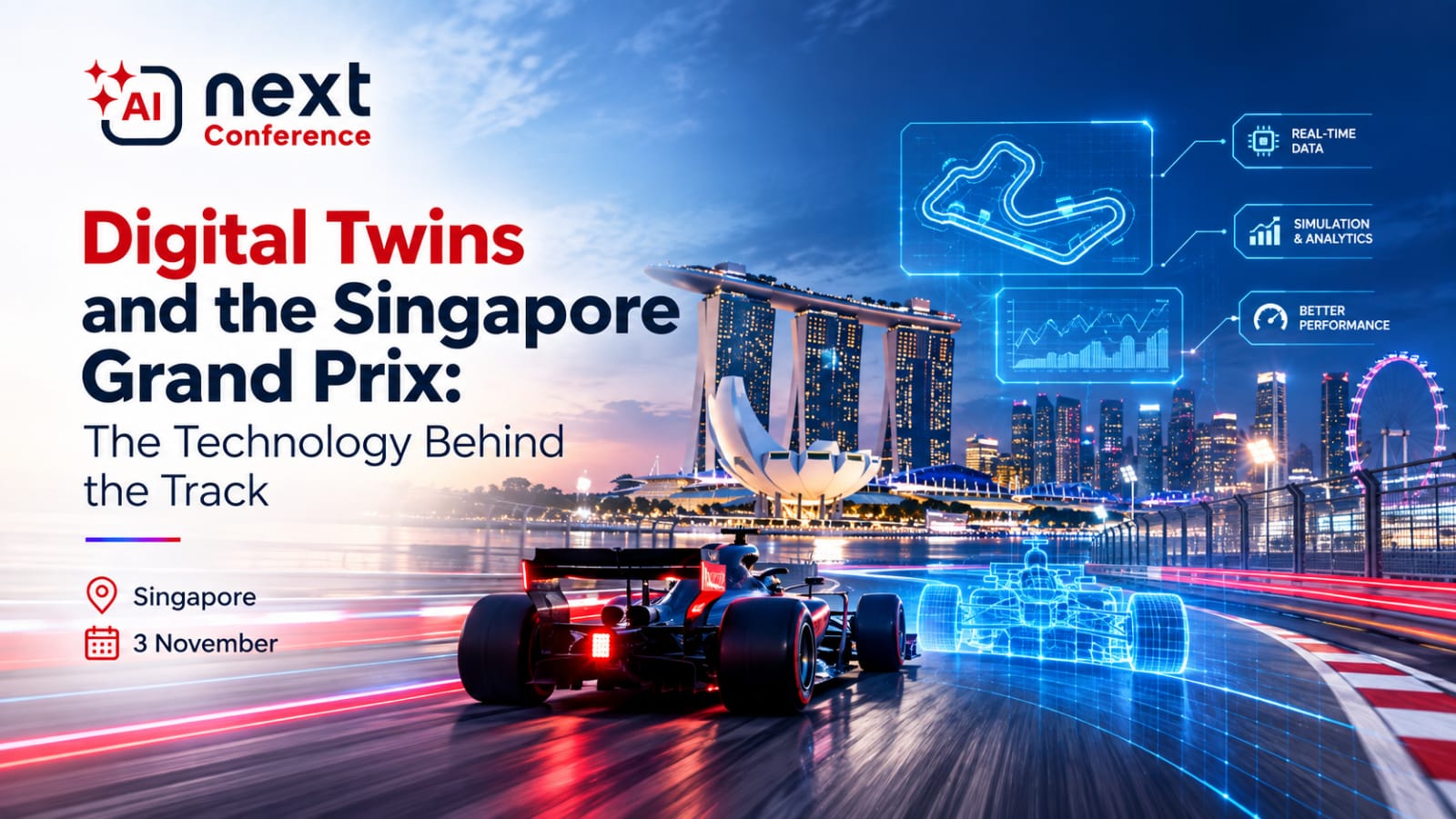
Each year, Singapore’s Marina Bay area undergoes a major transformation as public roads are converted into the Marina Bay Street Circuit for the Formula 1 Singapore Grand Prix. The temporary street circuit requires detailed planning across road infrastructure, transport, safety, utilities, event operations, and crowd management.
For spectators, the Singapore Grand Prix is visible through the racing, lighting, grandstands, and event facilities. Behind the scenes, however, the event depends on extensive data, connected systems, and digital planning. Technologies including digital twins, artificial intelligence (AI), Internet of Things (IoT) systems, and real-time data analysis can support the planning and management of complex urban environments.
Here is how these technologies are relevant to managing a major event within a functioning city.
The Living Blueprint: Virtualizing Marina Bay
Street circuits present different planning requirements from permanent racing venues. The track uses existing roads and urban infrastructure, meaning temporary event structures must be integrated with the surrounding city environment.
Digital models can help planners create detailed representations of roads, buildings, utilities, transport networks, and other infrastructure. These models can then be used to assess different scenarios before changes are made on the ground.
For a major event such as the Singapore Grand Prix, digital modelling can support areas including:
Infrastructure planning: Mapping roads, structures, utilities, and other assets that interact with the temporary circuit.
Scenario testing: Assessing how temporary structures, road closures, and changes in pedestrian movement could affect surrounding areas.
Operational planning: Coordinating different stages of circuit construction, event operations, and the subsequent reopening of roads.
This approach reflects the wider role of digital twins in Singapore, where digital models and data are increasingly being explored for urban planning, traffic management, and infrastructure operations.
AI and Data for Traffic Management
Converting city roads into a temporary race circuit requires careful coordination with Singapore’s wider transport network. Road closures and changes to traffic flows can affect commuters, public transport, businesses, and visitors.
AI and predictive analytics can support this type of planning by combining historical information with current traffic data. Such systems can help identify potential congestion points, model different traffic scenarios, and support decisions about road closures and alternative routes.
Singapore has already developed a strong foundation in data-driven urban management. Its Smart Nation initiatives use sensors, connected infrastructure, and data analytics to improve the management of city services.
For a large-scale event, these capabilities can help planners understand how changes in one part of the road network may affect movement elsewhere.
IoT and Crowd Management
Managing large numbers of visitors is another important part of a major city event. Sensors, cameras, connectivity systems, and data analytics can provide information about pedestrian movement and crowd density.
When combined with AI, these technologies can help operators identify areas where pedestrian numbers are increasing and support decisions about crowd routing, security, and access management.
Singapore has also used AI-enabled systems and unmanned aerial vehicles for crowd monitoring during major events in the Marina Bay area. These applications demonstrate how connected technologies can provide authorities with additional information when managing large public gatherings.
The same principle applies to the wider event environment: real-time information can help teams respond to changing conditions rather than relying only on pre-planned arrangements.
The AINext Awards and Conference
The Singapore Grand Prix provides a useful example of how technology can support complex operations within an active urban environment. Digital models, AI, IoT networks, and real-time data can help organizations plan infrastructure, manage movement, and respond to changing conditions.
For enterprise leaders attending AINext Awards and Conference Singapore, the broader lesson extends beyond motorsport. Similar technologies can be applied to ports, airports, industrial facilities, campuses, transport networks, and other environments where physical infrastructure and digital systems need to work together.
As cities and businesses become increasingly connected, digital twins and AI are becoming useful tools for testing scenarios, improving operational visibility, and supporting data-driven decisions before changes are implemented in the physical world.