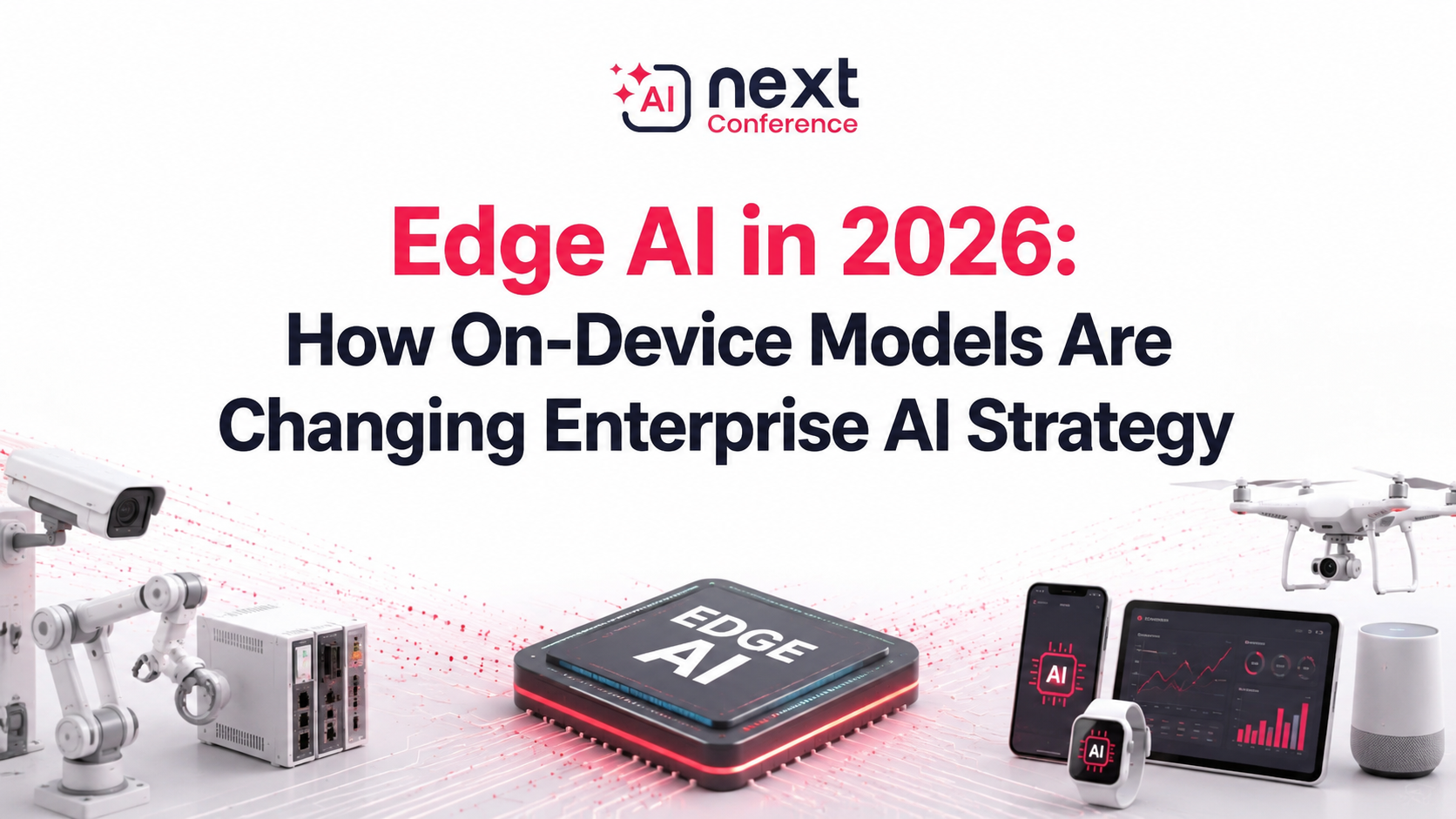
The Shift No One Saw Coming
The enterprise AI playbook is being rewritten. Google DeepMind's release of Gemma 4 12B—an open-weight, multimodal AI model that can run locally on laptops with 16 GB of RAM—highlighted how rapidly capable open-weight models can run on commodity hardware, challenging the long-held assumption that advanced AI always requires large-scale cloud infrastructure. Thanks to advances in model compression, aggressive quantization, and purpose-built architectures, many AI capabilities that previously required cloud infrastructure can now run efficiently on laptops, smartphones, and edge devices.
Why Edge AI Is No Longer Optional
Four unavoidable forces are driving enterprises away from cloud-only inference:
Near-Zero Latency: Cloud round-trips introduce unacceptable delays for real-time user experiences. On-device inference eliminates network delays entirely.
Ironclad Privacy: Data that never leaves the device cannot be intercepted in transit. As organizations prepare for additional EU AI Act obligations coming into effect during 2026, minimizing unnecessary data transfers is becoming an increasingly important compliance consideration.
Massive Cost Savings: Shifting inference workloads to user hardware drastically reduces recurring cloud serving bills for thousands of endpoints.
Total Reliability: Local models work without an internet connection. This is critical for field operations, aviation, and remote industrial sites.
The Tech Enablers Driving the Evolution
Three technological breakthroughs have made it possible to run advanced AI models on consumer-grade hardware:
Encoder-Free Architectures: Gemma 4 12B eliminates separate multimodal encoders, integrating vision and audio directly into the LLM backbone—reducing latency and memory usage.
Quantization Breakthroughs: Training in 16-bit and deploying at 4-bit precision preserves most model quality while reducing memory footprint by 4 times.
Speculative Decoding: Small draft models propose multiple tokens in parallel, validated by the target model—delivering 2–3 times speedups without sacrificing accuracy.
The Enterprise Hybrid-Edge Framework
To scale effectively, many organizations are adopting a hybrid deployment framework that places workloads where they perform best. A simple rule of thumb is:
Keep workloads local when:
•Highly sensitive data is involved
•Sub-millisecond latency is required
•Tasks involve compact context and frequent inference
Escalate to the cloud when:
•Long-context reasoning is required
•High-accuracy specialist models are needed
•Centralized execution is more cost-effective for batch workloads
Governance at the Edge
As Edge AI expands the deployment surface, organizations should implement device-aware governance, including:
•Signed model artifacts and verified runtime loading
•Policy bundles versioned independently from app releases
•Safety parity tests between local and cloud paths
•One-click runtime rollback capability
The Sustainability Dividend
Edge AI is no longer just a technical choice—it can also support broader Environmental, Social, and Governance (ESG) objectives.
Data Center Relief: Offloading suitable AI workloads to edge devices reduces demand on centralized data centers, lowering electricity and water consumption for those workloads.
Resource Optimization: Processing data locally can reduce network traffic and repeated cloud inference, improving overall compute efficiency in appropriate deployment scenarios.
Circular Economy: Optimizing AI software to run efficiently on existing devices extends hardware lifecycles and helps reduce electronic waste.
Join the Conversation at AINext 2026–2027
If you are navigating this transition, you do not have to build your framework in isolation. The upcoming AINext Conference series brings together AI leaders, technology executives, and innovators to explore practical strategies for deploying AI with governance, scalability, and sustainability at its core.
The series features three strategic regional editions:
AINext Dubai (22 October 2026) – Exploring AI adoption across high-growth markets.
AINext Singapore (3 November 2026) – Examining enterprise AI and the evolving regulatory landscape in Asia-Pacific.
AINext US in Las Vegas (8 April 2027) – Discussing strategies for scaling enterprise AI across North America.
Register now: ainextconference.com