
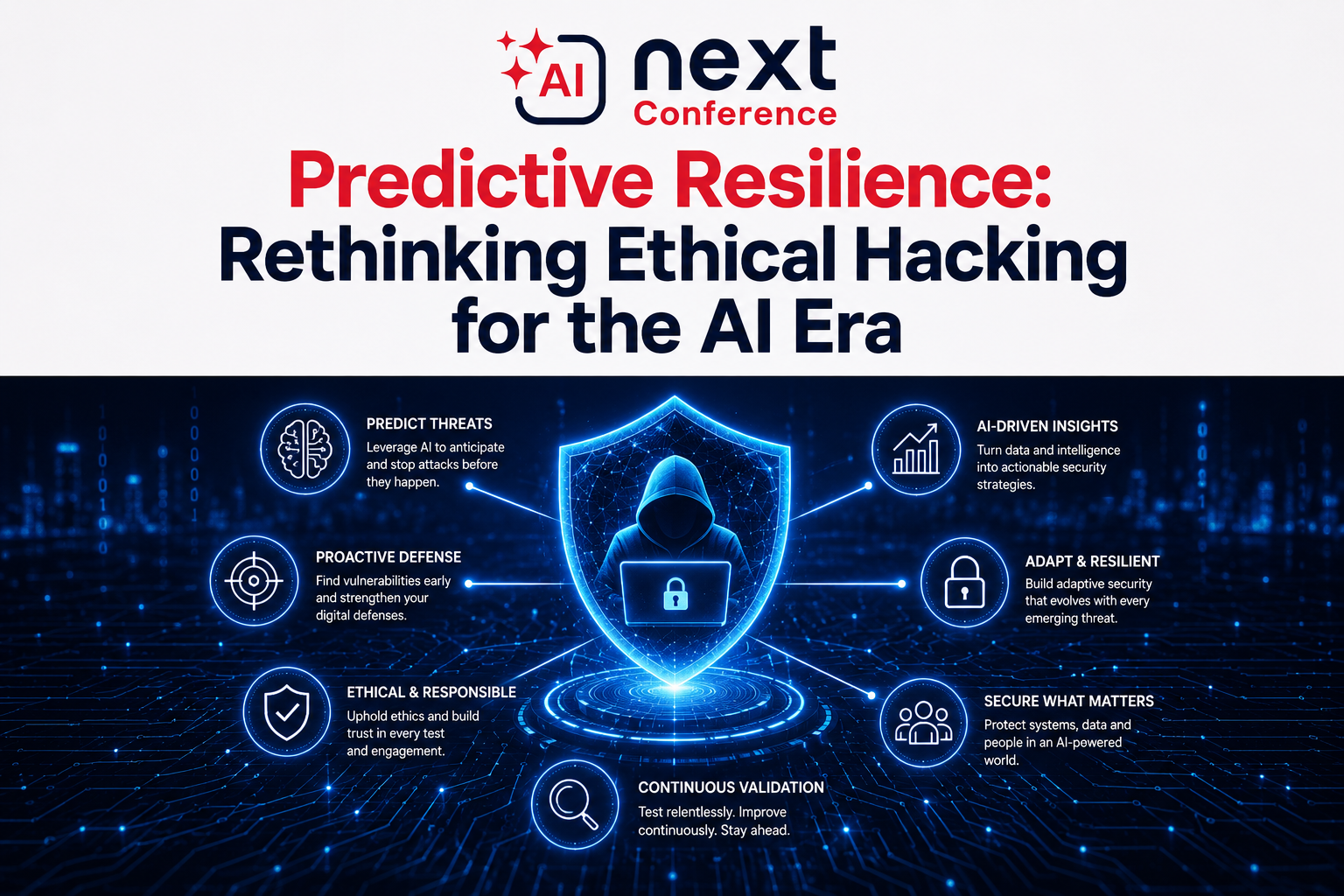
Artificial intelligence is transforming cybersecurity. Traditional ethical hacking—scheduled penetration tests, manual assessments, and scripted red-team exercises—remains essential but is no longer sufficient against AI-powered threats that evolve in real time. Attackers now use generative models to scale phishing, discover vulnerabilities faster, generate malicious code, and adapt tactics dynamically. Ethical hacking must become AI-native: a partnership between human experts and intelligent automation that finds risks before they’re exploited.
From Periodic Testing to Continuous Validation
Penetration tests capture a moment in time. Modern enterprise environments change continuously as cloud workloads, APIs, connected devices, and AI models are deployed and updated. AI-powered ethical hacking enables continuous validation by monitoring infrastructure, prioritizing vulnerabilities by business risk, and automatically mapping potential attack paths. Rather than reacting, organizations can proactively harden defenses before threats materialize.
AI as a Force Multiplier for Security Teams
AI augments rather than replaces ethical hackers. Machine learning models can analyze millions of events, detect subtle anomalies, correlate threat feeds, and suggest likely exploitation scenarios. That scale lets security teams focus human judgment where it matters: interpreting findings, assessing business impact, and making trade-offs. Combined, AI-driven analysis and human oversight yield faster, more accurate outcomes.
Reframing Ethical Hacking for AI Risks
To remain effective, ethical hacking must broaden its remit:
Model-aware testing: Assess data poisoning, model inversion, prompt injection, and drift within CI/CD and deployment workflows.
Scalable threat emulation: Use AI to generate realistic attack chains and automate red-team scenarios, while keeping humans in the loop for intent and impact analysis.
Risk-based prioritization: Fuse AI detections with business context to rank findings by operational, reputational, and regulatory harm.
Operational Capabilities to Build
Security leaders should invest in:
•adversarial ML testing integrated into development pipelines,
•autonomous purple-teaming loops that convert red outputs into automated blue-team playbooks,
•explainable AI so automated decisions are auditable,
•robust data lineage controls to protect training datasets and feature stores from manipulation.
Governance and Ethics as Enablers
Governance prevents harm during testing (for example, accidentally exposing PII) and keeps teams within legal boundaries. Establish clear rules of engagement for adversarial tests, use privacy-preserving techniques during assessments, and keep transparent logs for auditability. Responsible AI practices and documented human oversight build trust in automated security actions.
People and Cross-Functional Collaboration
Create hybrid teams where security engineers understand ML concepts, data scientists incorporate threat models, and product owners prioritize secure-by-design models. Cross-functional purple teams—blending product, ML, and security—speed secure deployments and enable coordinated responses to emergent threats.
From Prevention to Resilience
Perfection is impossible; resilience is the goal. Ethical hacking must test recovery: can models be rolled back quickly, can you trace data lineage, and can incidents be contained without major disruption? Track mean time to detect and fix model-related incidents alongside traditional patch metrics.
Looking Ahead
The future of ethical hacking is intelligent, continuous, and predictive. Organizations that combine skilled ethical hackers, AI-powered security platforms, and strong governance will convert simulated adversary insight into operational strength.
Explore these ideas and more at the AINext Awards & Conference series, where industry leaders discuss how intelligent technologies are redefining digital trust and enterprise resilience.