
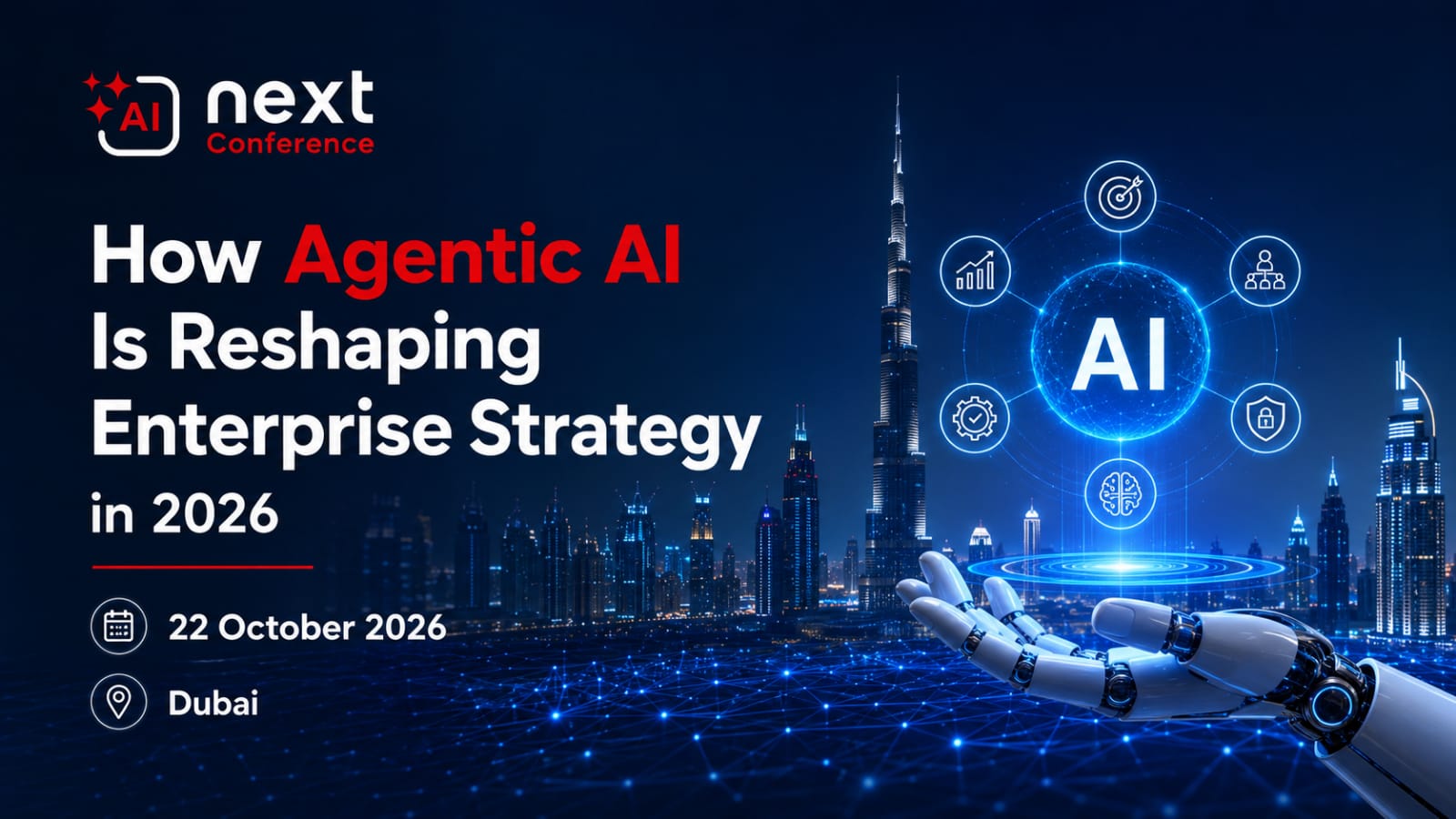
Artificial intelligence is entering a new phase. In 2026, the conversation is moving beyond generative AI that creates content or answers questions toward agentic AI: systems that can reason, plan, coordinate tasks, use tools, and execute actions with a degree of autonomy.
For enterprises, this shift is significant. Agentic AI is not only changing how teams work; it is also influencing how companies design strategies, build workflows, and measure business value. As organizations across Dubai and the wider UAE accelerate digital transformation, agentic AI is emerging as an important capability for improving efficiency, responsiveness, and innovation.
From Generative to Agentic
Generative AI has enabled businesses to automate tasks such as writing, summarization, search, and customer interactions. Agentic AI takes this a step further by enabling systems to work across multiple steps, use connected tools, respond to changing conditions, and support decisions within defined workflows.
The distinction is important. Generative AI typically produces an output in response to a prompt, while agentic systems can pursue a defined objective by planning actions, interacting with business systems, and adjusting their approach based on the situation.
Most enterprise work is not a single prompt or one-time task. It involves processes, dependencies, approvals, exceptions, and context. Agentic AI is designed to operate within these more complex environments. Instead of simply generating an answer, it can help execute parts of a workflow while operating within predefined rules and human oversight.
This is why agentic AI is increasingly viewed as a new stage in enterprise AI adoption. It can move AI from a productivity tool toward an operational capability embedded in how work gets done.
Why Enterprises Are Paying Attention
Enterprises are paying attention to agentic AI because its potential extends beyond individual productivity gains. By coordinating tasks across systems and workflows, AI agents can help organizations improve execution speed, reduce manual effort, and respond more quickly to changing business conditions.
Businesses are under increasing pressure to do more with fewer resources while maintaining service quality. Agentic AI can support these priorities by handling repetitive coordination tasks, retrieving information from multiple systems, and escalating decisions that require human judgment.
The most promising applications are typically multi-step workflows, such as:
• Customer service resolution across multiple systems
• Sales lead qualification and follow-up
• Procurement and supply chain coordination
• Finance operations and reporting
• IT support and incident management
• Internal knowledge search and task execution
These use cases are particularly relevant because they connect AI capabilities directly to measurable business processes and outcomes.
The Dubai Advantage
Dubai’s Universal Blueprint for AI is creating a policy environment that can accelerate AI adoption across sectors. Dubai is well positioned to explore the next phase of enterprise AI because its focus on digital transformation, innovation, and technology-led economic development gives organizations space to test and deploy emerging capabilities.
The opportunity spans multiple industries. Financial services can apply AI to risk management, compliance, customer operations, and document-intensive processes. Real estate can use AI for lead management, property analysis, and customer engagement. Logistics and trade can apply intelligent systems to forecasting, routing, and operational coordination, while healthcare can explore AI for administration, access to services, and decision support.
This cross-sector potential matters because agentic AI is not limited to one industry or function. Its ability to connect information, tools, and workflows makes it relevant to startups, SMEs, large enterprises, and public-sector organizations alike.
What Changes in Strategy
Agentic AI changes enterprise strategy in several important ways.
First, it changes how leaders think about productivity. The objective is no longer simply to make employees faster. Organizations can redesign workflows so that AI handles routine activities while employees focus on judgment, creativity, problem-solving, and relationship-building.
Second, it changes how companies build and connect their technology systems. AI agents need controlled access to relevant data, applications, tools, and workflows. This makes integration, identity and access management, data quality, and governance increasingly important parts of enterprise AI architecture.
Third, it changes how organizations measure value. Success should not be judged only by AI adoption rates, the number of pilots launched, or model performance. Leaders should also track business outcomes such as reduced cycle times, lower operating costs, improved conversion rates, faster resolution, and stronger customer retention.
Finally, it changes the operating model. As AI takes on more workflow responsibilities, business, technology, risk, compliance, and security teams need to work together to define where AI can act independently and where human approval remains necessary.
In this sense, agentic AI can push enterprises from AI experimentation toward operational execution.
The Challenges Ahead
Despite its potential, agentic AI is not a plug-and-play technology. Greater autonomy introduces new operational and governance challenges, including data quality, cybersecurity, model reliability, incorrect actions, process failures, and unclear accountability.
Governance becomes increasingly important as AI takes on more responsibility. Enterprises need clear boundaries around what an AI agent is permitted to access and execute, when human approval is required, how exceptions are escalated, and how actions and decisions are recorded for auditability.
There is also an organizational challenge. Having the technology is not enough. To use agentic AI effectively, companies may need to redesign processes, develop new skills, establish appropriate controls, and align IT, security, compliance, and business teams around common objectives.
The organizations that succeed will therefore be those that combine autonomy with appropriate controls rather than pursuing automation for its own sake.
What Leaders Should Do Now
Enterprise leaders should begin by identifying workflows where agentic AI can create measurable business value. Strong candidates are usually repetitive, rules-based processes that involve multiple steps, systems, or handoffs.
A practical approach includes:
• Select one or two high-impact use cases.
• Map the workflow, dependencies, and decision points.
• Assess the data, integrations, permissions, and system access required.
• Define governance, escalation, approval, and human-oversight rules.
• Establish measurable business and operational KPIs.
• Test the system in a controlled environment before expanding its scope.
• Scale only after demonstrating measurable value and acceptable risk.
This approach keeps agentic AI adoption grounded in business requirements rather than technology hype.
The Road Ahead
Agentic AI will not replace enterprise strategy, but it will increasingly influence how strategy is executed. The organizations that benefit most will be those that treat AI as part of their operating model rather than as a tool for isolated tasks.
For Dubai’s business community, this could create a new dimension of competitive advantage. Organizations that combine AI capability with strong governance, redesigned workflows, reliable data, and clear business objectives will be better positioned to turn emerging technology into measurable results.
The strategic question in 2026 is therefore not simply whether enterprises should adopt agentic AI. It is where AI-driven autonomy can create meaningful value, what level of autonomy is appropriate, and where human judgment must remain essential.
AINext Awards & Conference brings together business leaders, technology experts, and innovators to examine the next phase of artificial intelligence, including agentic AI and its implications for enterprise transformation. The conference provides a platform to explore emerging AI developments, practical adoption strategies, governance, and the opportunities for organizations to turn AI innovation into measurable business value.
Register now: https://ainextconference.com
Reference: McKinsey — The State of AI in 2025