
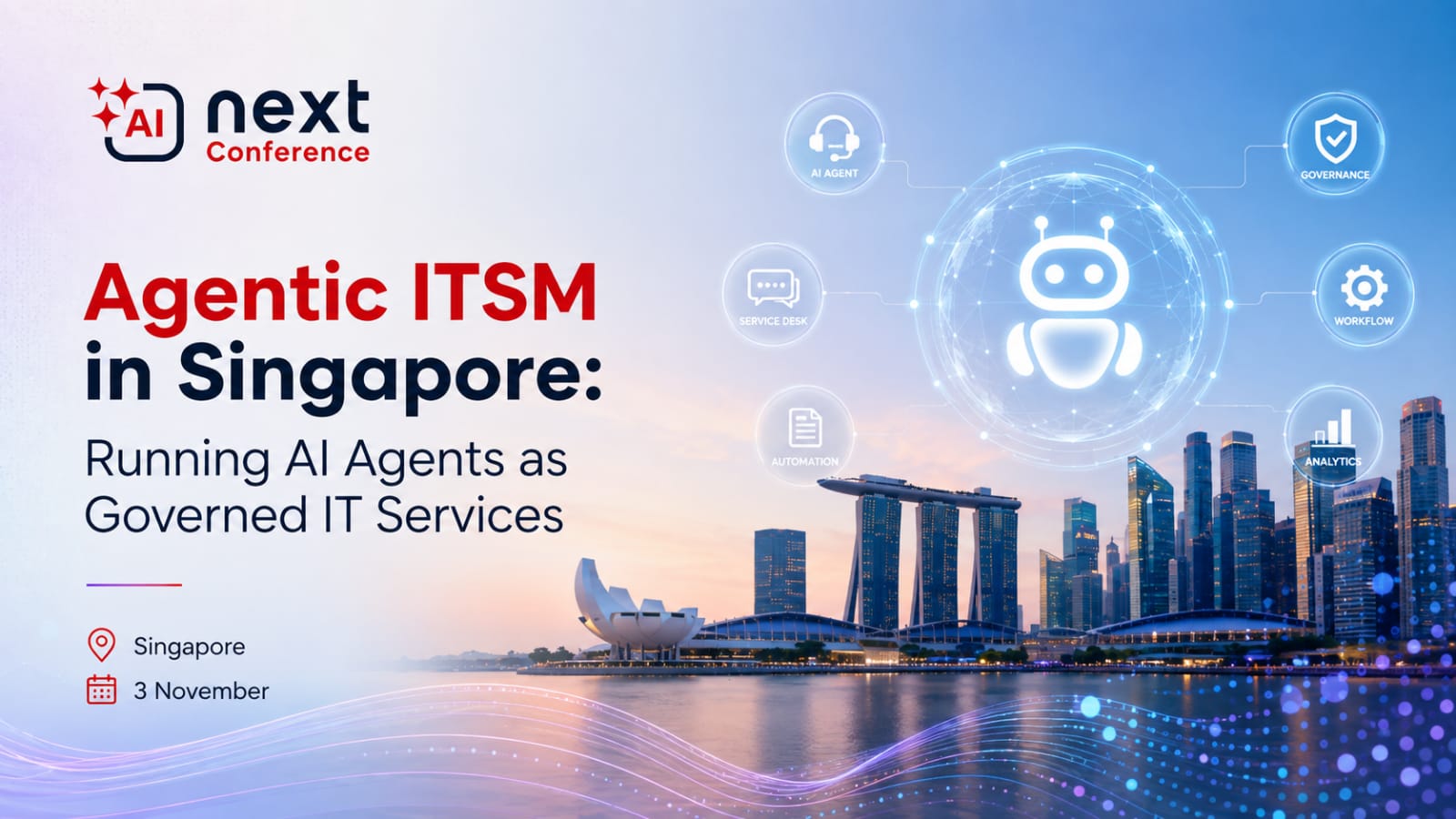
Singapore is emerging as a major hub for responsible artificial intelligence, digital infrastructure, and enterprise technology. As organizations move beyond AI assistants and experiment with autonomous AI agents, the next challenge is not simply deploying intelligent systems—it is managing them as reliable, secure, and governed IT services.
This is where Agentic IT Service Management (ITSM) is becoming increasingly important.
From AI Assistants to AI Agents
Traditional AI tools typically respond to prompts or perform individual tasks. Agentic AI goes further by allowing systems to plan, make decisions, use tools, execute workflows, and respond to changing conditions with limited human intervention.
In an IT environment, an AI agent could monitor infrastructure, identify an incident, investigate its potential cause, recommend or initiate remediation, update a service ticket, and escalate the issue when human intervention is required.
This shift can significantly change how IT service teams operate. Instead of managing every individual task, IT professionals increasingly need to supervise networks of AI agents performing operational activities.
Agentic ITSM: A New Operating Model
Agentic ITSM brings together AI agents, automation, IT service management, and enterprise governance. Instead of treating AI agents as isolated technology experiments, organizations can manage them as operational service components with defined purposes, owners, permissions, performance metrics, and escalation paths.
For example, an AI agent handling password-reset requests could verify approved user information, guide users through secure self-service steps, and create a service ticket when necessary. However, it should not bypass identity-verification requirements, access unrelated personal data, or make privileged account changes without appropriate approval.
Similarly, an incident-management agent could analyze alerts, correlate events across monitoring tools, and identify likely causes. It might be authorized to restart a non-critical service through a pre-approved runbook, while actions affecting production environments, customer-facing applications, or regulated systems would require human approval.
This approach creates a controlled balance between AI autonomy and human accountability.
Why Agentic ITSM Matters
The value of Agentic ITSM lies in its potential to shift IT operations from reactive ticket handling toward more proactive and intelligent service delivery. AI agents can analyze operational data, prioritize incidents, coordinate workflows, and support faster resolution across increasingly complex IT environments.
For IT teams, this can reduce repetitive workloads and allow human specialists to focus on complex incidents, strategic improvements, and decisions requiring organizational context. As enterprises manage hybrid infrastructure, cloud services, cybersecurity events, and growing volumes of operational data, agentic systems can also help identify patterns and coordinate responses in near real time.
Singapore provides a relevant environment for exploring this model, given its advanced digital ecosystem and focus on trustworthy AI. The Infocomm Media Development Authority (IMDA) Model AI Governance Framework for Agentic AI, Version 1.5 (May 2026) emphasizes areas including bounded autonomy, meaningful human oversight, technical controls, and end-user responsibility.
These principles are particularly important in IT operations, where an improperly configured agent could make an incorrect change, expose sensitive information, or act beyond its intended scope. Strong identity controls, least-privilege access, monitoring, testing, audit trails, and human escalation mechanisms can help keep autonomous actions within defined boundaries.
The objective is therefore not simply to automate more IT tasks, but to create faster, more proactive, and more adaptive service operations without compromising accountability and control.
Building Governed AI Services
The next phase of enterprise AI will require organizations to treat AI agents as operational services rather than experimental software tools. Each agent needs clear ownership, defined service expectations, controlled access, accountability, monitoring, and lifecycle management.
In an Agentic ITSM model, this means establishing:
•Named business and technical owners accountable for the agent’s performance, risks, and changes.
•A distinct, verifiable identity and scoped credentials, with least-privilege access to systems and data.
•Explicit tool and data boundaries, supported by technical guardrails that limit the agent to the capabilities required for its role.
•Approval gates and intervention triggers for high-risk or irreversible actions, particularly those affecting production, financial transactions, or regulated systems.
•Immutable audit trails recording decisions, tool calls, actions, and outcomes for compliance and post-incident review.
•Lifecycle controls covering onboarding, testing, versioning, monitoring, updates, and eventual decommissioning.
The objective is to make every AI agent observable, accountable, and controllable throughout its operational lifecycle. Agentic ITSM can provide the structure for incorporating these capabilities into existing IT operations while supporting Singapore’s broader focus on responsible and trustworthy AI.
Join the Conversation
AINext Singapore 2026 will bring together industry experts and enterprise leaders to explore the future of intelligent service management.
The event will focus on practical questions around AI-agent deployment, governance frameworks, service design, automation, risk management, and the operating models required to scale AI responsibly.
Date: 3 November 2026
Location: Singapore