
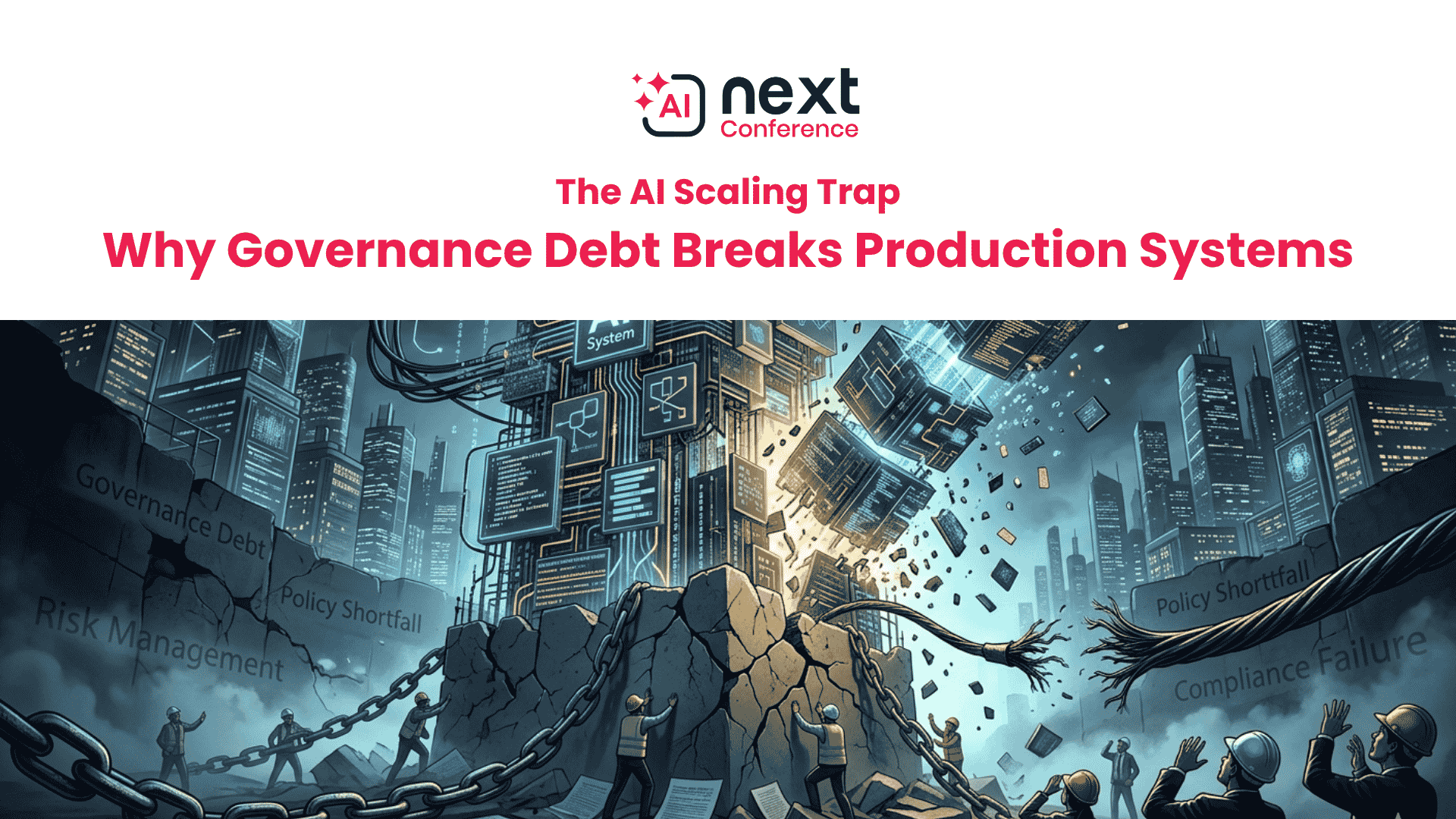
Many AI teams fall into the same pattern: a brilliant demo that impresses five stakeholders quietly collapses when scaled to 5,000 users. That moment is the AI scaling trap—where technical success in a sandbox meets the harsh realities of production: latency, data drift, bias, and runaway costs.
The root cause is rarely the model itself. It’s governance debt: ad‑hoc approvals, manual checks, and fix‑it‑later processes that break the moment AI moves beyond the POC. When governance isn’t baked into the pipeline from day one, production systems become fragile, expensive, and hard to trust.
From POC to Production: What Actually Breaks
POCs operate under artificially stable conditions:
• Curated datasets
• Limited concurrency
• Continuous human oversight
Production environments introduce:
•High‑throughput demand and latency constraints
•Noisy, unstructured, and adversarial inputs
• Expanding compliance and policy requirements
A typical failure pattern: a GenAI customer‑support assistant performs well in testing. After deployment:
• Query volume increases 100 times
•Prompt variations introduce ambiguity
• No evaluation layer exists to validate outputs
Within weeks:
• Hallucination rates increase
• Inconsistent responses erode user trust
• Token usage spikes due to unbounded retries and agent loops
The system doesn’t collapse—it degrades silently.
Governance Debt: The Hidden Constraint
Most teams defer governance:
• Monitoring is postponed
• Prompt validation is informal
• Compliance review is reactive
This creates governance debt—accumulated gaps in control, visibility, and accountability.
In production, this manifests as:
• Slow approvals and deployment friction
• Shadow AI systems outside formal oversight
• Limited traceability across models, prompts, and outputs
Governance becomes a bottleneck precisely because it was never designed into the system.
Three Systemic Failure Modes
At scale, three failure classes dominate:
1. Cost Instability
Unbounded API calls, inefficient orchestration, and recursive agent behavior drive unpredictable spend.
2. Data Drift and Semantic Degradation
Input distributions shift. Without continuous evaluation, model relevance declines faster than retraining cycles.
3. Trust Erosion
Hallucinations, bias, and unsafe outputs propagate before detection, undermining user confidence and regulatory compliance.
These are not edge cases—they are structural outcomes of unmanaged scale.
Governance as Architecture, Not Process
Effective AI systems treat governance as part of the runtime architecture.
Key patterns include:
Inline controls: PII masking, prompt-injection detection, and policy enforcement embedded in inference pipelines
Continuous evaluation (EvalOps): automated scoring of outputs for accuracy, safety, and bias using LLM-based evaluators
Full traceability: centralized registries tracking model versions, prompts, datasets, and ownership
In this model, governance is not a checkpoint. It is a continuous control system integrated into CI/CD and inference orchestration.
Sovereign AI and FinOps as Scaling Levers
Sovereign AI
Workload segmentation becomes critical:
• Public APIs for low-risk tasks
• Self-hosted or fine-tuned models for sensitive or regulated data
This reduces exposure while maintaining flexibility.
FinOps for AI
Cost control shifts from reactive to programmatic:
• Model and usage tagging by team and function
• Token budgets, rate limits, and real-time alerts
• Cost visibility at the pipeline and feature level
Sustainability at scale requires financial governance embedded alongside technical governance.
Reframing the Problem
AI is no longer an experimental capability. It is an operational system.
The constraint is not model intelligence—it is system discipline.
Organizations that scale AI successfully do not just build better models. They build:
• Observable systems
• Controlled pipelines
• Governed workflows
Governance is no longer a compliance layer. It is a scaling primitive.
The next generation of AI platforms will not be differentiated by model performance alone, but by how effectively they operationalize control, accountability, and cost discipline at scale.
This transition—from experimentation to engineered systems—is central to discussions at AINext Conference 2026, where governance‑first architectures are increasingly defining production success.