
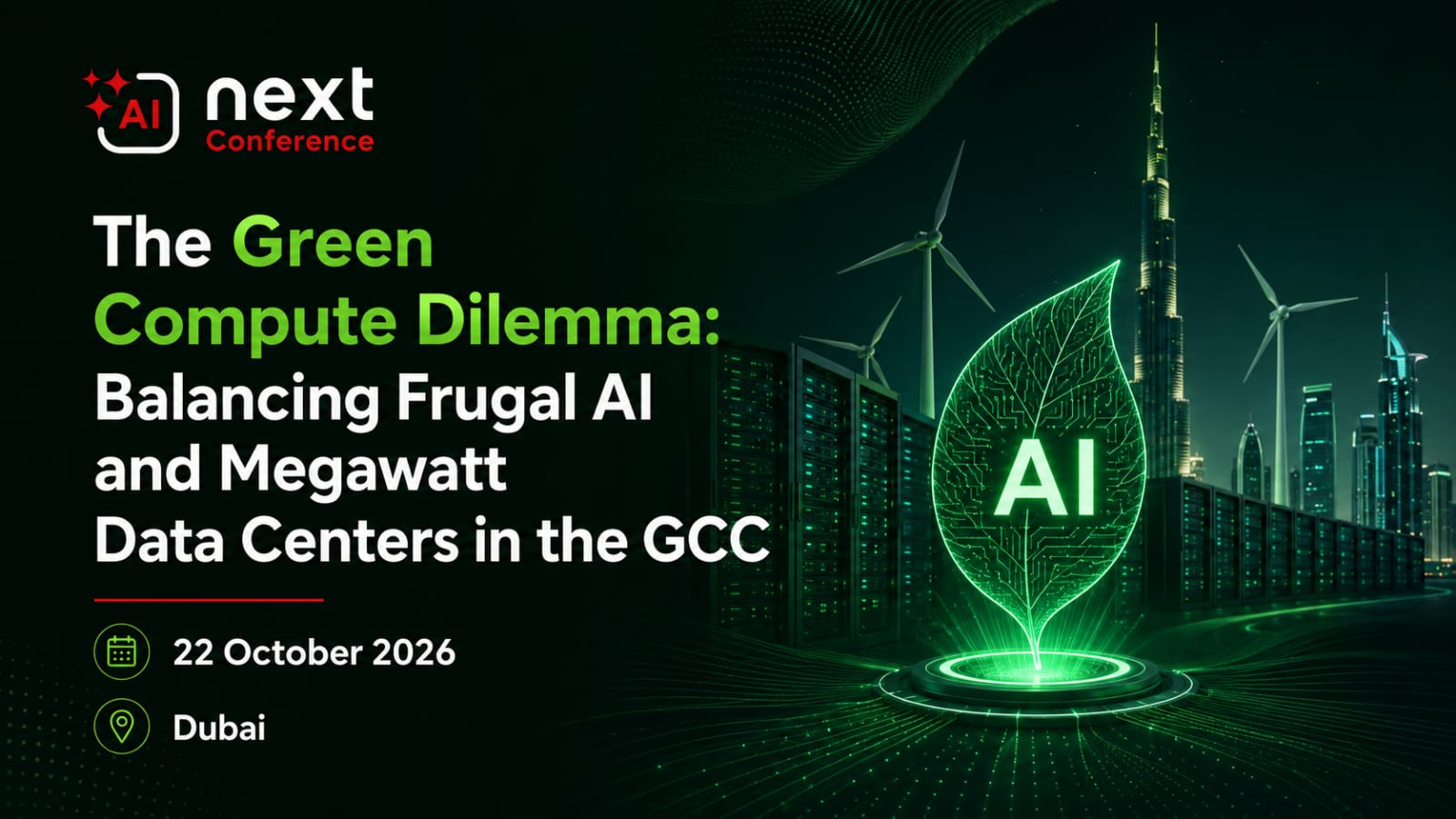
The Gulf Cooperation Council (GCC) is fast becoming an epicenter of the global AI computing race—and it has a rare advantage: the ability to build large-scale, energy-efficient compute infrastructure from the ground up.
From solar-powered data centers in Dubai to sovereign AI initiatives in Abu Dhabi and Riyadh, the region is turning its energy resources into a strategic asset for high-performance and more sustainable AI. As billions flow into next-generation infrastructure, the GCC now faces a critical question: how can it scale AI compute while keeping energy use, emissions and resource efficiency under control?
A Region Building AI Infrastructure the Right Way
Rather than retrofitting legacy data centers, the GCC is designing AI-ready, renewable-backed ecosystems that align with national net-zero goals:
•Dubai’s Warsan green data center (100+ MW) will run on 100% solar power from the Mohammed bin Rashid Solar Park, eliminating generation-related emissions for that facility.
•Pure DC’s Abu Dhabi campus has matched 100% of its 2025 electricity use with I-RECs and is expanding capacity under a decarbonized operational model.
•Across the region, new regulations and technologies are being explored that could cut data center energy consumption by up to 40%, alongside microgrid policies and efficiency rating systems.
In Abu Dhabi, the Stargate UAE project is targeting large-scale AI computing capacity, while Saudi Arabia’s sovereign AI company HUMAIN is expanding regional infrastructure and developing Arabic AI models such as HUMAIN M3.
The Middle East is not simply adopting artificial intelligence; it is building the infrastructure needed to support it at scale.
That ambition, however, comes with a difficult physical reality: extreme heat, demanding cooling requirements and rapidly growing electricity needs.
As AI computing capacity expands, the region faces a distinct challenge: the Green Compute Dilemma. How can the GCC reconcile high-performance AI ambitions with energy efficiency and long-term sustainability?
The answer does not lie in building fewer data centers. It lies in mastering Frugal AI.
Frugal AI: The GCC’s Efficiency Edge
Alongside this infrastructure boom, the region has a unique opportunity to make Frugal AI a default operating model for enterprise and government workloads. Frugal AI uses smaller, task-specific models, efficient architectures and carbon-aware operations to do more with less compute, helping organizations reduce costs and emissions while maintaining the required level of performance.
For GCC banks, telecoms operators, energy firms and logistics providers, this means:
Domain-tuned, smaller models for high-volume tasks such as customer service, document processing and back-office automation, rather than using large LLMs for every application.
Carbon-aware scheduling, shifting energy-intensive training and batch inference to periods when renewable electricity is most available.
Edge and regional inference to reduce data movement, improve latency and support data-residency requirements.
Research suggests that AI-related emissions can be significantly reduced by combining techniques such as quantization, pruning, model reuse and rigorous carbon accounting with energy-efficient infrastructure.
A Blueprint for Sustainable AI Leadership
The GCC’s path forward is not a trade-off between scale and sustainability; it is a chance to define a new standard for how AI should be powered:
• Continue building renewable-backed, high-efficiency campuses with strict energy and water performance targets, leveraging advanced cooling suited to Gulf climates.
• Embed energy and carbon metrics into AI procurement and KPIs, making efficiency a core criterion alongside accuracy and latency.
• Tie AI expansion to verified sustainability outcomes, using life-cycle assessments and public reporting to align with ESG frameworks and national net-zero goals.
A recent sustainability assessment of AI-driven data centers in the GCC concludes that net-positive outcomes are achievable when substantial renewable procurement, best-practice cooling, and transparent verification of AI benefits occur together—precisely the direction the region is already moving.
Turning Megawatts into Meaningful AI
The GCC’s challenge is no longer whether to build large AI data centers, but how efficiently those facilities can turn electricity into economic and societal value. By combining efficient infrastructure with frugal, high-value AI workloads, the region can make every kilowatt-hour of compute count while reducing emissions intensity.
This could give the GCC an opportunity to establish a global model for sustainable AI—one in which technological ambition and climate responsibility reinforce each other. The region’s advantage may ultimately depend not only on how much AI compute it builds, but on how intelligently it uses every megawatt.
The Path Forward
True technology leadership isn't measured solely by the number of advanced GPUs arriving at local ports or the scale of server farms being built in the desert.
The Middle East has a historic opportunity to set a new global benchmark. By pairing world-class, megawatt-scale infrastructure with lean, disciplined Frugal AI engineering, the region can demonstrate how national AI capabilities can scale sustainably—delivering greater intelligence and economic value with fewer resources.
The future of AI in the Gulf shouldn't just be massive. It must be remarkably efficient.
Join the conversation at the AINext Awards and Conference in Dubai, where regional leaders in AI, data centers and sustainability will explore real-world strategies for green infrastructure, Frugal AI and sovereign innovation.
Register now to secure your place and be part of shaping the next chapter of responsible AI in the Gulf.