Artificial intelligence is reshaping how organizations operate, compete and make decisions. Yet successful AI transformation depends on more than advanced systems or significant investment. It depends on people—their skills, judgement, confidence and ability to work effectively with AI.
Many organizations begin their AI journey by investing in platforms, models and automation tools. However, technology delivers value only when employees understand how to apply it to real business challenges. Without the right skills, confidence and organizational support, even the most advanced AI solution may remain an underused pilot rather than become part of everyday operations.
This makes AI literacy a strategic priority. Employees do not all need to become data scientists, but they should understand the capabilities and limitations of AI, how to evaluate its outputs and when human judgement is essential. Training must also be tailored to different roles. A senior leader may need to understand AI governance and investment decisions, while a customer-service team may require practical guidance on using AI responsibly in daily workflows.
Beyond technology adoption
The challenge begins when organizations move from AI experimentation to everyday adoption. Deploying a sophisticated platform is not enough; businesses must redesign workflows so that AI supports people where it can create measurable value.
This may involve identifying suitable use cases, reallocating responsibilities and establishing clear processes for reviewing AI-generated outputs. AI can handle repetitive analysis, identify patterns and provide recommendations, while employees contribute context, judgement and accountability.
The World Economic Forum's human-led AI framework identifies three responsibilities that remain fundamentally human: setting direction, exercising judgement and holding accountability.
This principle reinforces the need to position AI as a capability that strengthens human decision-making rather than a substitute for it.
Building trust inside the organization
Trust is another central component of AI transformation. Employees need clarity about how AI systems are being used, what information they process and where human oversight remains necessary.
Poorly governed AI can create concerns around transparency, accountability, privacy and decision-making. OECD research on AI in government similarly identifies governance, skills, data, transparency and oversight as important foundations for trustworthy adoption.
For businesses, this means AI policies should extend beyond technical teams. Employees, managers, compliance professionals and business leaders all need a shared understanding of acceptable AI use and the responsibilities associated with AI-assisted decisions.
Designing a human-centered AI workforce
Leadership must connect AI investment with clear business objectives rather than treating it as a standalone technology program. Effective transformation can involve starting with defined use cases, measuring outcomes, identifying new skills requirements and creating feedback mechanisms for employees.
Training should move beyond basic awareness towards practical capabilities, including evaluating AI outputs, working with AI agents, protecting sensitive information, understanding system limitations and applying human judgement.
The UAE’s national AI strategy emphasizes talent development and AI governance, while Dubai’s Universal Blueprint for Artificial Intelligence aims to accelerate AI adoption and strengthen the city’s position as a destination for technology, innovation and AI companies.
AI transformation ultimately becomes organizational transformation. The systems may be artificial, but their value depends on human decisions about where they are deployed, how they are governed and how effectively people work with them.
AINext Awards & Conference Dubai 2026
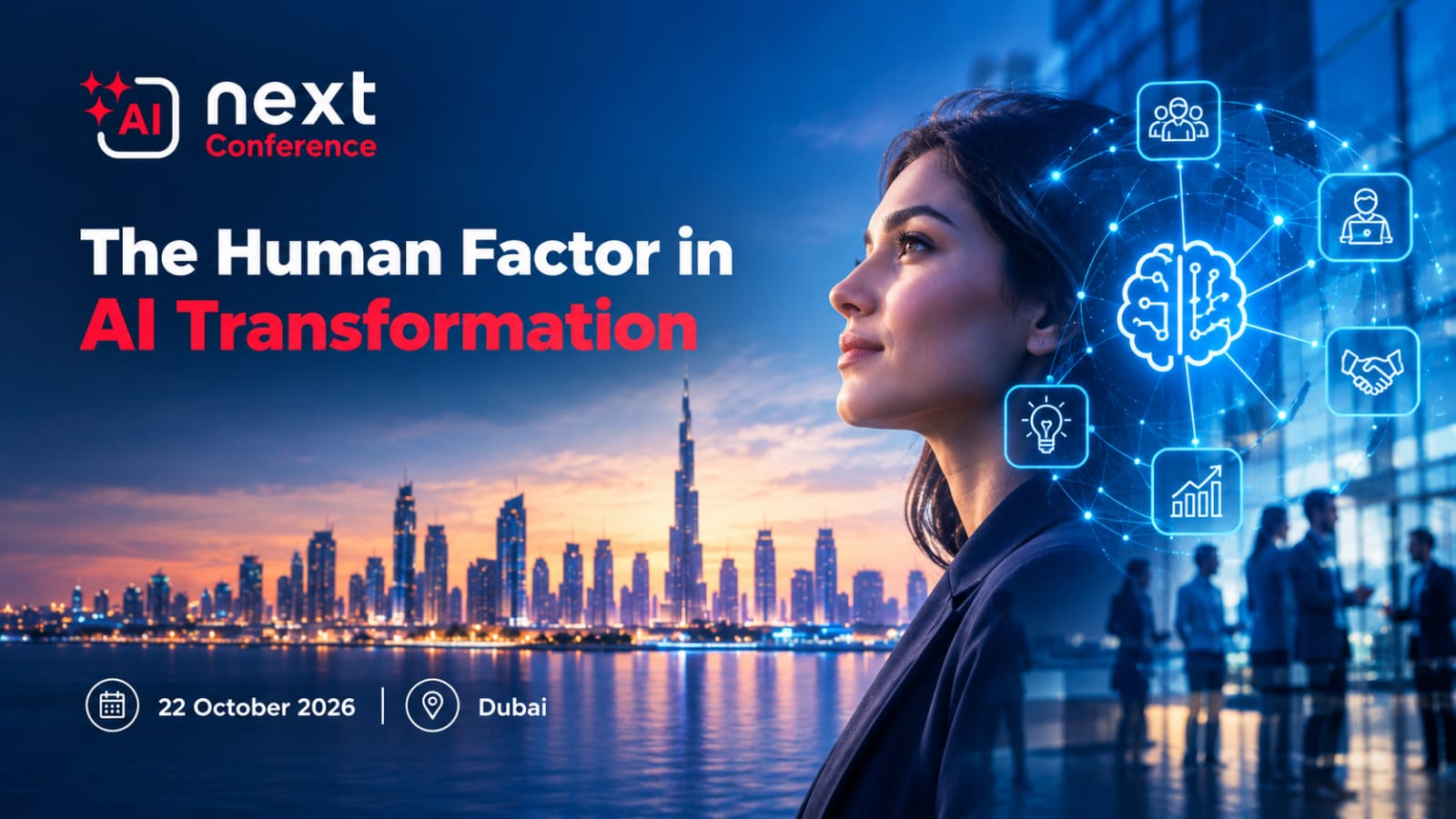
These themes will be explored at AINext Awards & Conference Dubai on 22 October 2026 at Crowne Plaza Dubai – Deira. Join AI leaders, innovators and business decision-makers to examine how organizations can build human-centered, responsible and scalable AI strategies.