
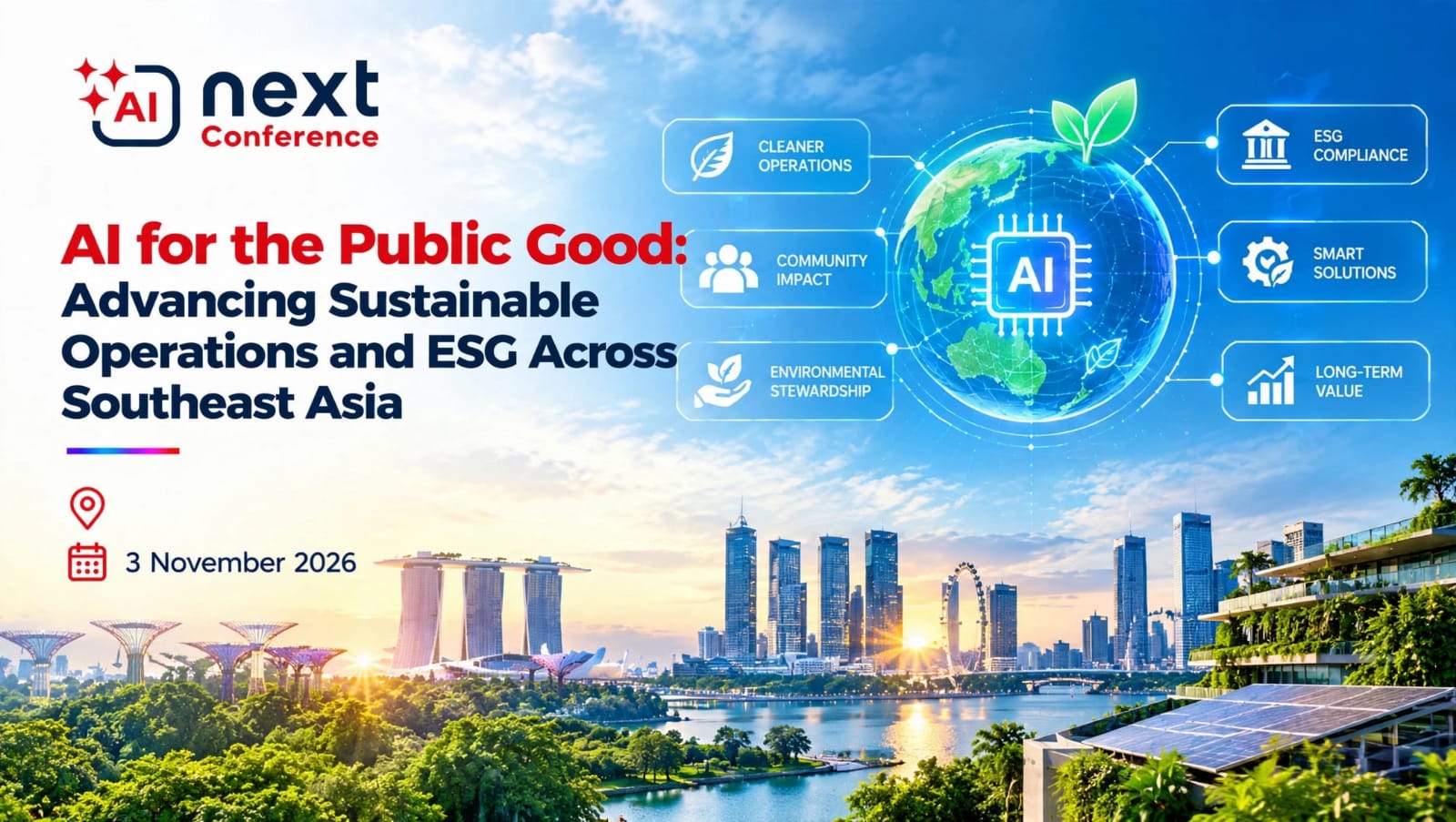
Artificial intelligence is no longer just a tool for productivity. Across Southeast Asia, it is becoming an operational layer for sustainability—helping organizations measure emissions, optimize energy use, strengthen supply-chain transparency, and make better climate decisions.
Singapore’s refreshed National AI Strategy reinforces this direction. Its vision is to harness AI for the public good, combining sectoral transformation, responsible governance, workforce readiness, and resource-efficient AI infrastructure. For businesses across the region, the message is clear: AI can create commercial value, but its greatest long-term impact will come when it is deployed to support environmental, social, and governance outcomes.
From reporting to real operations
Many organizations still treat ESG as a reporting exercise: collecting data, preparing disclosures, and responding to stakeholder expectations. AI can shift sustainability from retrospective reporting to real-time operational intelligence.
Machine learning can identify energy waste in buildings, forecast renewable generation, detect equipment faults before they cause downtime, and optimize logistics routes to reduce fuel consumption. In agriculture, AI-enabled insights can improve yields, monitor soil and water conditions, and support more sustainable farming practices. These applications are especially relevant in Southeast Asia, where power, transport, agriculture, and land use are deeply interconnected systems.
The opportunity is substantial. Southeast Asia’s Green Economy 2025 Report, estimates that systems-level solutions—including a sustainable bioeconomy, next-generation grid development, and electric-vehicle ecosystems—could deliver a 2% uplift in nominal GDP across the SEA-6 economies by 2030, equivalent to around US$120 billion annually. These solutions could also reduce emissions by roughly 300 MtCO2e, helping close about half of the region’s emissions gap to its 2030 climate pledges.
Green AI as an enabler
AI’s role in sustainability is often described through three functions: information, prediction, and optimization. It can make complex environmental data usable, anticipate risks before they escalate, and identify the most efficient course of action across assets, networks, and supply chains.
For example, AI-driven grid balancing, predictive maintenance, and generation forecasting can help utilities integrate more renewable energy while maintaining reliability. In transport, AI can support charging-infrastructure planning, reduce congestion, and optimize energy demand. In agriculture and nature-based solutions, it can help maximize land productivity, improve waste management, and strengthen carbon-sequestration efforts.
This is why Green AI is increasingly viewed as an enabling solution rather than a niche technology. It connects data, capital, and infrastructure across sectors, helping sustainability strategies deliver measurable operational outcomes.
The responsibility to build responsibly
AI cannot be considered sustainable if its own environmental footprint is ignored. Training and running large models requires significant compute and energy. Organizations therefore need to match the model to the task, avoid unnecessary compute, monitor energy and carbon intensity, and prioritize efficient architectures and data practices.
Singapore is addressing this challenge directly. Its updated AI strategy includes a commitment to advance resource-efficient AI and secure sufficient compute access in line with sustainability goals, alongside efforts to develop energy-efficient and green data centers. This signals an important shift: AI infrastructure must be designed not only for performance and scale, but also for energy efficiency and environmental accountability.
Responsible deployment also requires governance. Businesses should establish clear accountability for AI-supported sustainability decisions, validate data quality, protect privacy and security, and ensure that AI benefits extend across the workforce and supply chain. Singapore’s strategy emphasizes trusted AI adoption through sustained governance, stronger societal assurance, and inclusive growth.
What leaders should do next
Organizations in Southeast Asia can move from ambition to action by focusing on a few practical priorities:
•Identify high-impact use cases in energy, logistics, agriculture, manufacturing, and facilities management.
•Build reliable emissions, energy, and supply-chain data foundations before scaling AI.
•Set measurable outcomes for carbon reduction, efficiency, resilience, and cost savings.
•Embed human oversight and governance in decisions affecting communities, workers, and the environment.
•Assess the carbon and energy footprint of AI systems alongside their business benefits.
The road ahead
Southeast Asia’s green transition will not be achieved through isolated projects. It requires connected systems, cross-border collaboration, credible finance, and technologies that turn sustainability data into action. AI can be one of the most powerful connectors—if organizations deploy it responsibly.
For Singapore and the wider region, the challenge is not simply to adopt AI faster. It is to ensure that AI helps build cleaner operations, stronger supply chains, more resilient energy systems, and more inclusive economic growth. That is what it means to use AI for the public good.
Join AINext Awards and Conference Singapore 2026 on 3 November to explore how responsible AI, sustainable operations, and enterprise innovation can shape Southeast Asia’s next phase of growth. Register now. https://ainextconference.com