
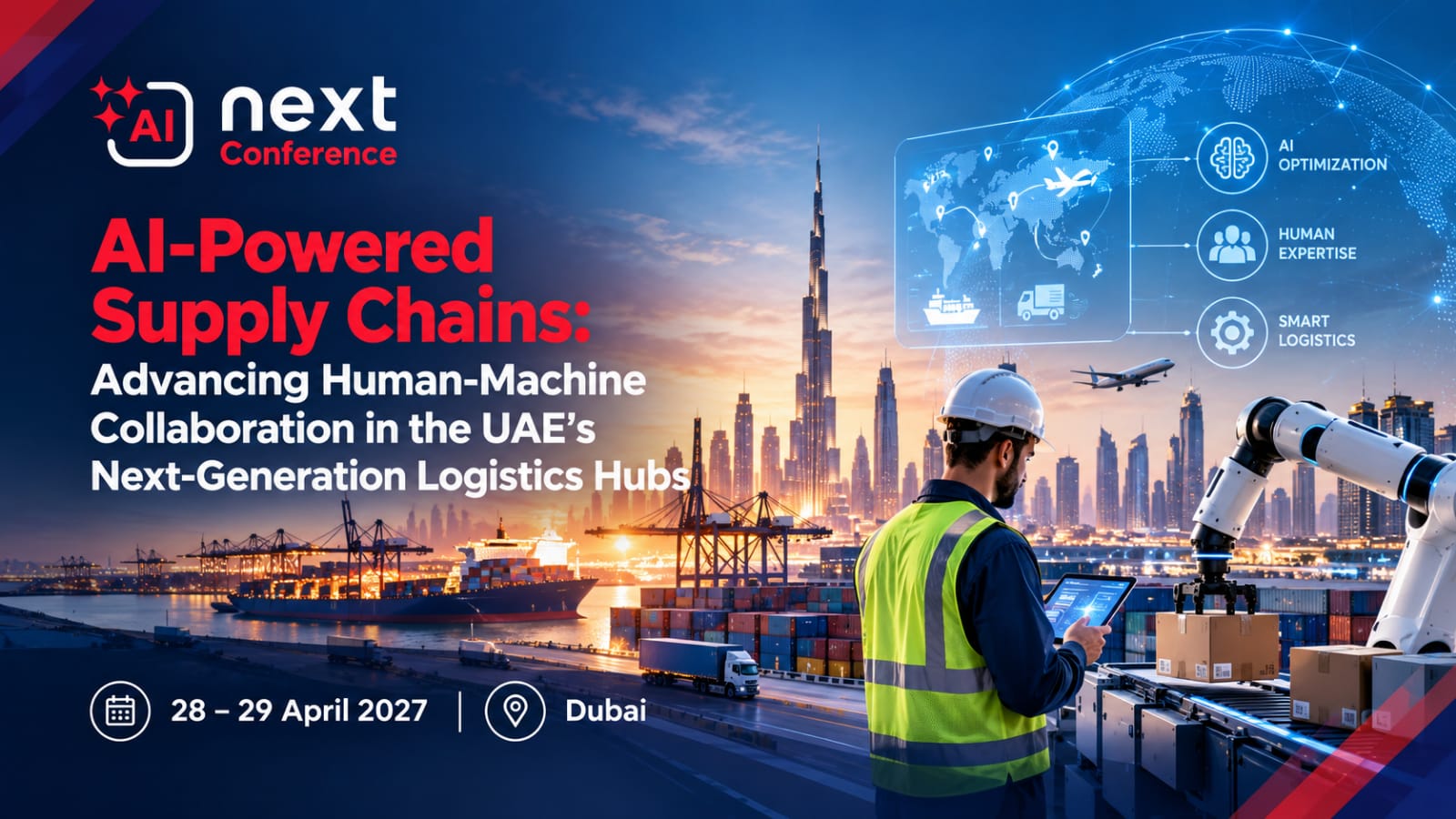
The UAE has established itself as one of the world’s leading logistics and trade hubs. With advanced ports, airports, free zones, warehousing infrastructure, and access to markets across Asia, Africa, and Europe, the country is well positioned to lead the next era of supply-chain innovation.
That era will not be defined by automation alone. It will be shaped by human-machine collaboration, where AI predicts, detects, and recommends, while people provide judgment, oversight, and accountability.
From visibility to intelligent decision-making
For many years, supply-chain digitalization focused on visibility: tracking shipments, digitizing documents, and connecting partners. These capabilities remain important, but they are no longer enough.
Today’s logistics leaders need faster decision-making. They must anticipate demand changes, manage exceptions, reroute shipments, optimize inventory, and respond to disruption before customers are affected.
AI enables this shift by converting operational data into timely, actionable insight. Machine learning can improve demand forecasting, identify supply risks, recommend replenishment levels, and optimize delivery routes. Computer vision can support quality control, safety monitoring, and warehouse operations. Digital twins can simulate the flow of goods across ports, warehouses, and transport networks.
Together, these technologies move supply chains from reactive operations to intelligent, adaptive networks.
Where AI creates value
The UAE’s logistics ecosystem offers strong conditions for AI adoption because it combines high trade volumes, complex cross-border operations, advanced infrastructure, and a concentration of global businesses.
High-value use cases include:
Predictive demand planning: AI can analyze sales history, seasonality, promotions, weather, and market signals to improve forecasting.
Warehouse optimization: Intelligent systems can improve slotting, picking routes, labor allocation, and order fulfilment.
Computer vision: AI-enabled cameras can monitor safety compliance, inspect packages, detect damage, and support quality checks.
Transport optimization: AI can evaluate traffic, fuel costs, delivery windows, vehicle capacity, and real-time disruptions.
Port and airport operations: Predictive models can support cargo-flow management, equipment utilization, and delay prediction.
Exception management: AI can identify delayed shipments, customs issues, stock shortages, or supplier risks and route them to the right decision-maker.
The UAE is already demonstrating what this looks like in practice. Dubai Customs is developing its Advance Cargo Information (ACI) system, which uses AI to analyze shipment data before arrival, strengthen risk assessment, and support faster customs decision-making. Meanwhile, DP World’s CARGOES platform provides digital solutions that support terminal operations, cargo management, and supply-chain visibility. These developments show how digital technologies can give logistics professionals better information, improve operational efficiency, and support more informed decisions.
These applications do not remove people from the process. They reduce manual effort and allow teams to focus on higher-value decisions.
Human-machine collaboration is the advantage
The most successful AI deployments will not be fully autonomous. They will be designed around a clear division of responsibility.
AI is strong at processing large volumes of data, identifying patterns, running scenarios, and generating recommendations. Humans are strong at interpreting context, managing exceptions, negotiating with partners, and making decisions involving incomplete information or business risk.
For example, AI may identify a likely inbound shipment delay, estimate its impact on inventory and customer orders, and recommend alternative suppliers or transport routes. A supply-chain planner can then review the recommendation, add commercial context, and approve the best action.
This approach improves speed without sacrificing accountability. It also builds trust among operational teams, which is essential for adoption.
Implementation requires more than technology
AI in supply chains is an operating-model transformation, not just a technology project. Many organizations face fragmented data across ERP, warehouse-management, transport-management, procurement, and customer systems.
Common barriers include poor data quality, legacy-system integration, cybersecurity risks, limited AI skills, workflow resistance, and difficulty measuring ROI.
The best approach is to begin with focused use cases such as demand forecasting, warehouse labor planning, or exception detection. Organizations can prove measurable value, strengthen data foundations, and then expand into more connected AI capabilities.
Governance is equally important. Companies need clear policies for data access, model performance, bias testing, cybersecurity, vendor management, and human oversight. Responsible AI is not a barrier to innovation; it is the foundation for scale.
The UAE opportunity
The UAE is well placed to become a global reference point for AI-enabled logistics. Its infrastructure, trade connectivity, digital-economy ambitions, and growing AI ecosystem create a powerful environment for innovation.
The future logistics hub will not simply be more automated. It will be more intelligent, connected, resilient, and human-centered. Organizations that invest now in data readiness, workforce capability, and responsible AI governance will lead the region’s next generation of supply-chain excellence.
Join the conversation
How can AI and human-machine collaboration make supply chains more intelligent, efficient, and resilient?
Join AINext Awards & Conference Dubai 2027 to connect with AI leaders, enterprise innovators, technology providers, and decision-makers exploring the future of AI-driven business transformation.
Learn more: https://ainextconference.com