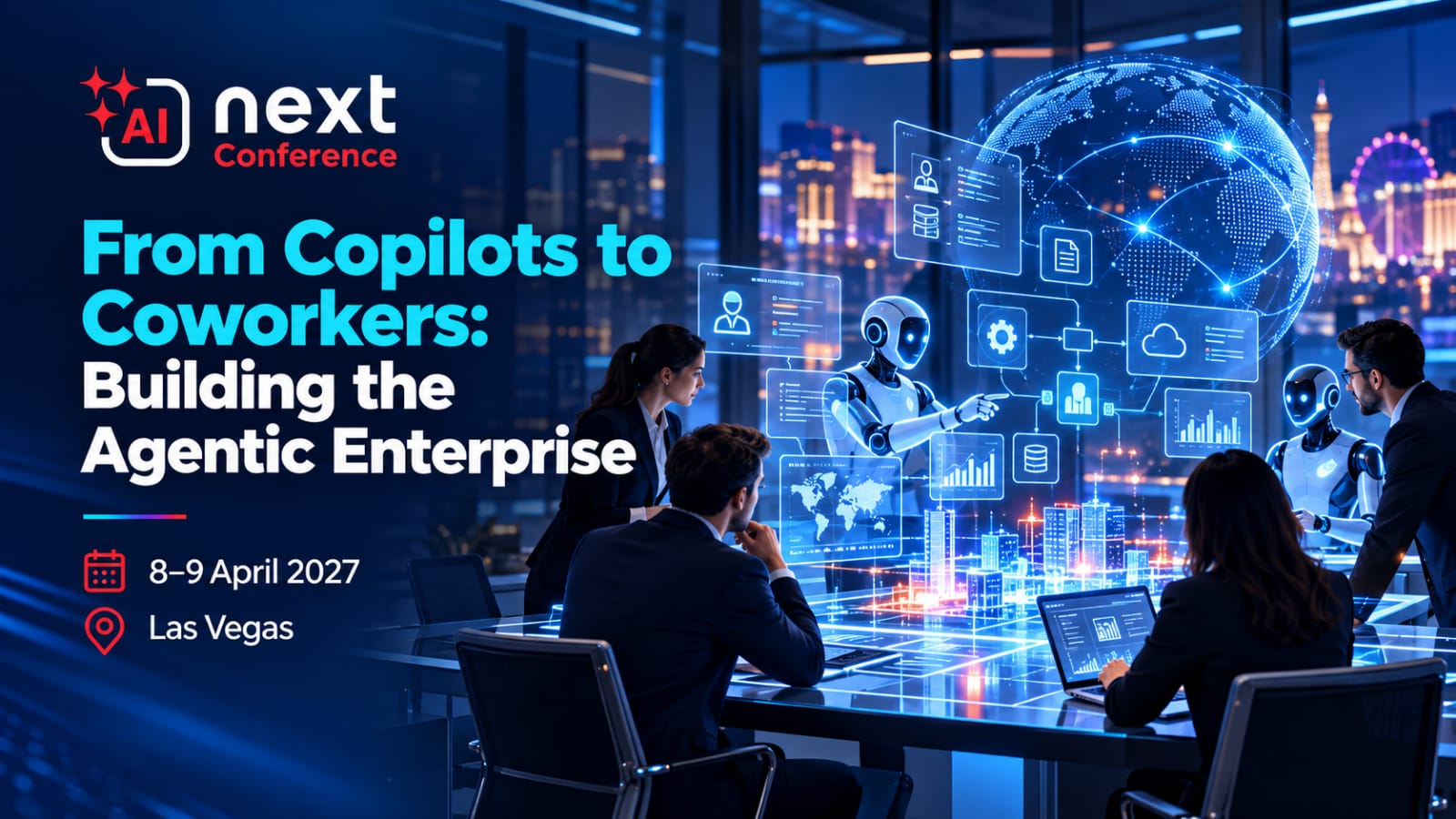
Artificial intelligence is entering its next phase. Organizations are no longer asking whether AI can generate content, answer questions, or support individual tasks. The bigger question is how intelligent systems can understand goals, plan actions, use tools, collaborate across systems, and deliver measurable outcomes across the enterprise.
This is the shift from copilots to coworkers—from AI that assists people to agentic AI that can actively participate in business workflows.
Agentic AI represents a major evolution beyond traditional generative AI. Instead of relying only on human prompts, AI agents can be designed to pursue objectives, break down complex tasks, interact with applications and data, and adapt their approach as conditions change.
For enterprises, this creates new opportunities across operations, customer experience, finance, supply chain, cybersecurity, healthcare, manufacturing, and professional services. An AI agent could help coordinate procurement workflows, support customer-service escalation, monitor operational risks, prepare decision-ready insights, or assist teams with repetitive, multi-step processes.
But autonomy also raises important questions. How much decision-making should be delegated to AI? How do organizations maintain transparency, accountability, security, and human oversight? And how can leaders ensure that agentic systems create business value rather than adding complexity?
From experimentation to enterprise value
Many organizations have already moved beyond early AI experiments. They are deploying copilots, automating workflows, integrating AI into customer-facing systems, and using predictive intelligence to improve decision-making.
The next challenge is scale.
An AI pilot may demonstrate potential, but an enterprise-grade AI system must deliver consistent performance, integrate with existing technology, protect sensitive data, meet regulatory expectations, and show measurable business impact. This requires more than powerful models. It requires strong data foundations, secure infrastructure, clear ownership, change management, and governance.
Leaders must also rethink how work gets done. As AI takes on more operational tasks, human roles will shift toward judgment, creativity, oversight, relationship-building, and strategic decision-making. The most successful organizations will not simply replace tasks with automation. They will redesign workflows so people and AI systems can collaborate effectively.
Governance becomes a competitive advantage
As AI becomes more autonomous, governance can no longer be an afterthought. Organizations need clear frameworks for model risk, data privacy, security, bias mitigation, auditability, and human accountability.
This is especially important as AI agents begin to take actions across systems. A poorly governed agent may create operational risk, expose confidential information, make inconsistent decisions, or act beyond its intended scope. A well-governed agent, by contrast, can improve speed and consistency while maintaining appropriate human control.
Responsible AI is therefore not a barrier to innovation. It is a foundation for trust, adoption, and long-term value creation. Enterprises that build governance into their AI strategy early will be better positioned to scale confidently and responsibly.
The human-AI enterprise
The future enterprise will be built around collaboration between people and intelligent systems. AI can process information, identify patterns, and execute defined tasks at scale. Humans bring context, ethics, creativity, empathy, and strategic judgment.
The organizations that succeed will be those that invest in both technology and people. They will build AI literacy across teams, empower employees to use AI responsibly, and create new roles focused on AI oversight, data quality, model performance, and workflow design.
The shift from copilots to coworkers is not about removing humans from the loop. It is about elevating human contribution while enabling AI to handle complexity at scale.
Join the conversation
The future of AI will not be defined by tools alone. It will depend on how responsibly and effectively organizations turn intelligence into action.
Join AINext Awards & Conference Las Vegas 2027 on 8–9 April 2027 to explore the agentic enterprise, connect with global AI leaders, and help shape the future of intelligent business.
Register now. https://ainextconference.com