
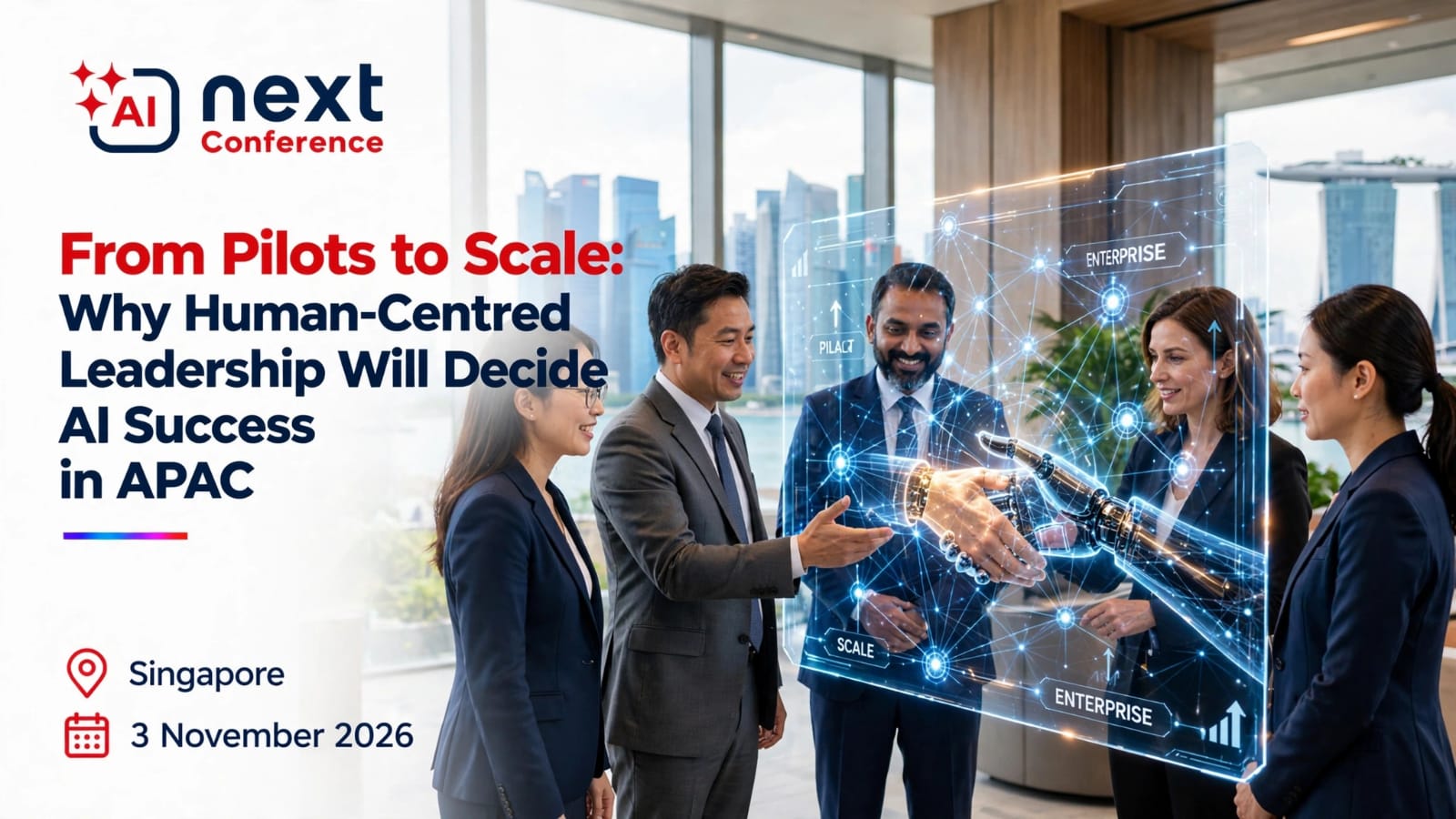
Across Asia-Pacific, AI has moved beyond the proof-of-concept stage. Enterprises are deploying generative AI, predictive analytics, computer vision and intelligent automation to improve customer experience, streamline operations and support faster decision-making. However, the biggest challenge is no longer developing an AI model. It is making AI reliable, trusted and valuable at enterprise scale.
That is where human-centred leadership becomes essential.
The scaling gap
Many organizations can demonstrate an impressive AI pilot, but struggle to turn it into a production-ready capability. The barriers are rarely technical alone. They include unclear ownership, fragmented data, weak change management, limited employee trust and the absence of clear accountability for outcomes.
Successful AI deployment requires leaders to connect technology with a specific business problem, prepare data and infrastructure, define measurable goals and establish governance that supports innovation. AI initiatives are more likely to deliver value when they are aligned with business priorities and supported by effective leadership.
DBS Bank’s CSO Assistant offers a practical example. The generative AI tool supports around 1,000 customer service officers through real-time call transcription, knowledge retrieval, call summaries and service-request drafting. DBS reported nearly 100% accuracy in key pilot tasks and expects the assistant to reduce call-handling time by up to 20%. Close to 90% of participating officers also reported improvements in their workflow.
The example highlights an important lesson: AI adoption is not just about introducing new technology. It also requires employee training, workflow improvements and responsible oversight to turn a promising tool into a useful business capability.
Leadership as the control layer
Human-centred leadership does not mean slowing AI adoption. It means creating the conditions for AI to scale responsibly and deliver measurable results.
Effective leaders:
Set clear business goals: Define the problem each AI initiative should solve instead of adopting technology for its own sake.
Build cross-functional teams: Bring together technology, risk, operations, HR and customer experience teams to support implementation.
Maintain human oversight: Ensure appropriate review of high-impact decisions, particularly in finance, healthcare, recruitment and public services.
Prepare the workforce: Help employees understand how AI supports their roles and provide training to build practical skills.
Measure broader outcomes: Evaluate customer trust, employee adoption, risk reduction and long-term resilience alongside efficiency gains.
Governance is central to this approach. As AI systems influence decisions, organizations must address privacy, cybersecurity, transparency, bias and accountability. Responsible AI is not merely a compliance exercise; it builds confidence among customers, employees, investors and regulators.
The APAC opportunity
APAC’s diversity makes human-centred leadership even more important. Organizations operate across different regulatory environments, languages, cultural expectations and levels of digital maturity. An AI solution that succeeds in Singapore may need significant adaptation for Indonesia, Japan, India or Australia.
The region’s advantage lies in its ability to combine technological ambition with practical deployment. Singapore, in particular, has emerged as a strategic hub for AI innovation, investment and digital transformation, making it an important setting for cross-border collaboration.
Join the conversation at AINext Singapore
The organizations that win the next phase of AI will not simply have the best models. They will have leaders who can align people, governance, data and technology around measurable business value.
AINext Singapore 2026 takes place on 3 November 2026 in Singapore, bringing together C-suite leaders, AI innovators, technology professionals, investors and policymakers to explore enterprise AI deployment, governance, agentic AI, business transformation and responsible innovation.
Join the conversation on how human-centred leadership can help organizations move beyond AI pilots to deliver meaningful, measurable business outcomes.
Register now at ainextconference.com.