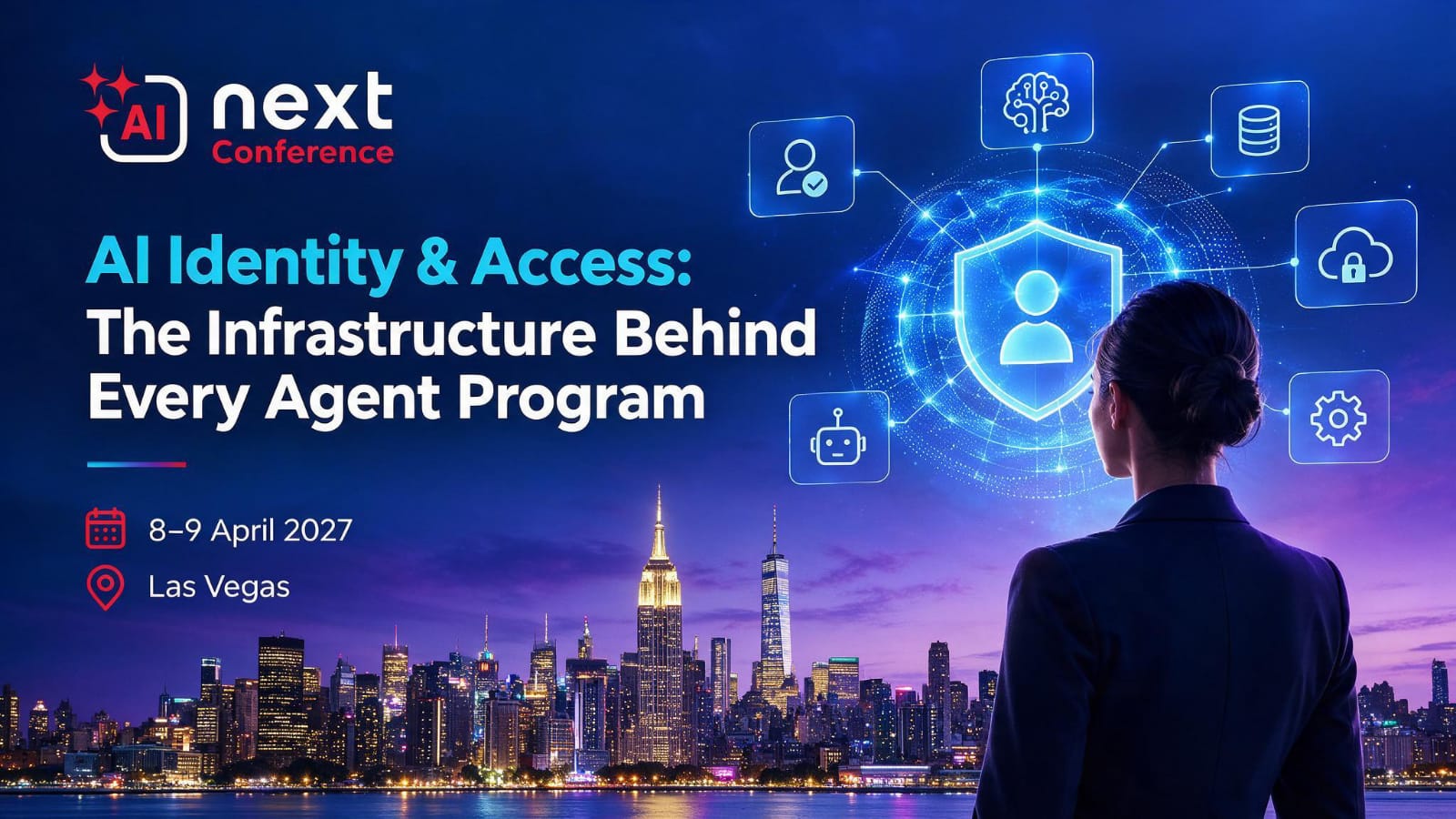
As organizations move agentic AI from experimentation into production, a less visible infrastructure layer is becoming increasingly important: identity and access for AI workloads. The question is no longer only which model an agent uses, but who the agent is, what it can access, what actions it can take, and how those actions can be traced back to an authorized request.
For enterprises deploying agents across applications, data, and business systems, identity and access are becoming core components of the AI architecture.
Why traditional IAM patterns do not fully fit agents
Traditional identity and access management (IAM) was designed primarily around people accessing applications and services. AI agents operate differently. They can authenticate through workload identities, service accounts, tokens, and delegated credentials, while requesting access to tools and downstream systems at runtime.
This creates new governance challenges. Credentials can become overly broad, permissions can persist longer than necessary, and conventional logs may not clearly connect an agent's actions to the human, application, or workflow that initiated them.
The Cloud Security Alliance's draft Agent Identity Governance Framework treats agent identity as a distinct governance challenge and identifies five agent identity types: copilot, autonomous agent, orchestrator, ephemeral sub-agent, and agent-as-a-service identities. Each has different requirements based on its autonomy, lifecycle, delegation authority, and access scope.
Different agents need different identity controls
Copilot identities operate under active human supervision. Their access can often be closely tied to a user's authenticated session and should expire appropriately when that session ends.
Autonomous agent identities operate without continuous human interaction, for example when responding to events, running scheduled tasks, or managing workflows. They require controlled credentials and clearly defined access boundaries.
Orchestrator identities coordinate other agents and may delegate work to sub-agents. Because they can influence multiple downstream actions, they require particularly strong authentication, authorization, and monitoring.
Ephemeral sub-agent identities are created for narrowly defined tasks and may exist only for seconds or minutes. Their identity, parentage, permissions, and termination should be automatically managed.
Agent-as-a-Service identities operate across multiple customers or tenants. Strong tenant isolation is essential to prevent data, credentials, or permissions from crossing organizational boundaries.
This classification highlights an important principle: an AI agent should not simply be treated as another service account. Its identity controls should reflect how autonomous it is, what authority it holds, how long it exists, and whether it can delegate work.
Authentication establishes identity; authorization defines authority
Authentication establishes which agent or workload is acting, using mechanisms such as workload identity, OAuth/OIDC, mutual TLS, or SPIFFE/SPIRE. Authorization then determines what that agent is permitted to do.
For agentic systems, the two must work together. An authenticated agent should not automatically have broad access to every tool or system. Permissions should be scoped to the task, resource, user context, and requested action.
The control set that scales
A practical approach to agent identity and access can be built around several core controls:
Unique identity per agent: Give each agent a distinct identity rather than sharing credentials across multiple agents. This limits the impact of a compromised agent and makes activity easier to attribute.
Task-scoped, short-lived credentials: Use credentials that are limited to a specific task, resource, and permitted action. Expire them when the workflow ends rather than relying on persistent access.
Runtime authorization: Do not rely only on static roles. Sensitive tool calls should be evaluated at the time of action, taking into account the target system, user context, requested operation, and data sensitivity.
End-to-end delegation: Maintain visibility into who initiated a task, which agent is acting on their behalf, which credentials were used, and which tools or downstream systems were accessed. This is particularly important across OAuth, MCP, service tokens, and workload identities.
Unified audit trails: Connect the human request, agent activity, tool calls, and resulting system changes. Fragmented logs can make it difficult to reconstruct what happened during an incident.
Automatic expiry and decommissioning: Build credential rotation and revocation into the lifecycle of agents and workflows so completed or retired agents do not retain unnecessary access.
Platform-layer governance: policy, runtime, and observability
At the platform layer, governance splits into three functional layers that keep agents safe without slowing delivery:
Policy: Define rules—virtual keys, budgets, allow/deny lists, model access, RBAC, and data classification.
Runtime: Enforce rules at request time—routing, guardrails, PII redaction, rate limits, key rotation, and fallback.
Observability: Measure and audit—token/cost tracking, prompt logging, audit trails, and distributed tracing exported to security, finance, and platform teams.
Together, these layers can centralize credentials, authorization, routing, budgets, rate limits, guardrails, and telemetry. This allows application teams to build agent workflows without recreating identity and security controls for every application.
The business case: accountability and speed
Strong agent identity and access controls address three practical challenges that can slow enterprise adoption: excessive permissions, unclear ownership, and insufficient evidence of what an agent actually did.
They can also support more consistent deployment. When agents use established identity systems and their actions are governed by explicit authorization policies, organizations can create clearer approval processes and more defined security boundaries.
The objective is not simply to restrict agents. It is to make their actions identifiable, authorized, traceable, and controllable as organizations scale agentic AI across the enterprise.
Explore the future of agentic AI at AINext Las Vegas
AINext Awards and Conference Las Vegas brings together enterprise leaders, technology architects, and AI practitioners to examine the infrastructure, governance, and production practices shaping the next phase of agentic AI.
Discussions will explore production architectures, AI governance, platform controls, and the identity and access foundations needed to scale agentic AI across the enterprise.