
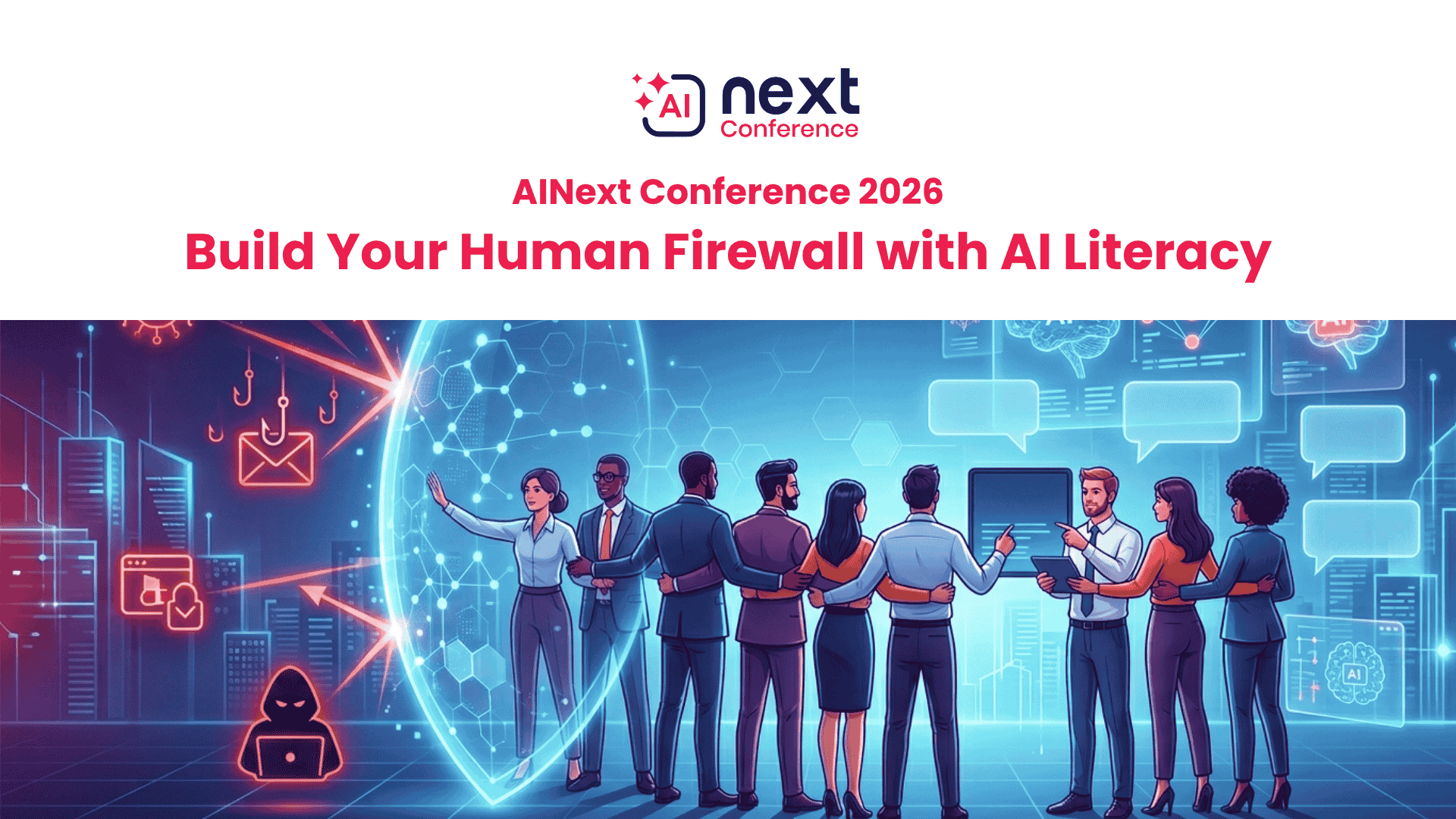
As we head toward AINext Conference 2026, at Horseshoe Las Vegas (May 21-22), the AI ROI narrative is shifting.
While most organizations chase speed and productivity, leading enterprises are prioritizing something far more strategic: risk mitigation savings.
In the era of autonomous agents, the biggest win isn’t faster workflows—it’s the million-dollar crisis your team successfully avoids.
The First Line of Defense: Your People
In 2026, AI doesn’t just assist—it acts. It executes decisions, moves data, and interacts autonomously.
That means errors aren’t just mistakes—they’re liabilities.
AI-literate teams are becoming the human firewall, capable of identifying and stopping risks before they escalate.
1.Catching the Confident Hallucination
Untrained users often trust AI outputs at face value.
AI-literate teams understand model uncertainty and probability—spotting confident but incorrect outputs before they reach client reports or legal documents, avoiding costly remediation cycles and reputational damage.
2.Stopping the Data Leak Early
Data leakage remains a top-tier risk. Literacy training ensures that every team member understands Shadow AI risks—knowing exactly what data is safe to feed into a model and what must remain behind a local firewall. In 2026, preventing a single data breach is often worth more than five years of productivity gains.
Signs Your AI Agent is Going Off-Script
Watch for these red flags:
• High confidence without verifiable sources
• Context drift into unrelated domains
• Repetitive loops in reasoning
• Unexpected PII/IP requests
• Ethical blind spots (EU AI Act violations)
• Performance inconsistencies
Catch these early—and you’ve just created invisible ROI.
Build the Human Firewall: A 3-Layer Model
Don't just spot risks—systematize prevention with this battle-tested framework:
1. Prompt Awareness
Ask of every outputs
Where is this coming from? (Transparency)
Can it be verified? (Validation)
Is it client-ready? (Judgment)
2. Risk Classification
Adopt a simple traffic-light system:
Green : Safe, routine queries
Yellow : Needs human review before action
Red : Restricted data (PII, IP, financials)—block immediately
3. Escalation Protocol
Automate decision triggers:
Novel/confident claims : Manual verification
Sensitive data requests : Immediate block
Autonomous actions : Log + manager review
Calculating the Invisible ROI
How do you measure the value of a disaster that never occurred?
The Compliance Hedge: Avoiding regulatory fines by ensuring AI workflows remain within GDPR or industry-specific guardrails.
Legal Cost Avoidance: Reducing the risk of intellectual property infringement or algorithmic bias lawsuits.
Brand Equity Protection: Maintaining customer trust by ensuring autonomous interactions remain ethical and accurate.
From Awareness to Fortress: Enterprise Reality
A significant share of breaches are attributed to human factors, while AI-driven Phishing is driving higher click rates in simulated environments.
Traditional training isn’t enough.
AI literacy must evolve into active defense capability.
2026 Enterprise Pillars:
Cognitive Defense: Recognize deepfakes, impersonation, and synthetic content
Adaptive Learning: Embed micro-training directly into workflows
Fiduciary Responsibility: Treat data governance as a core business mandate
HumanFirewall Banking Case Study
One enterprise banking client reported a 45% phishing simulation failure rate despite existing filters. After deploying HumanFirewall's AI platform—with role-specific simulations, real-time error-based training, and gamification—failure rates dropped from 45% to 3% within six months.
Threat remediation times were reduced to seconds, resulting in estimated annual savings of $2M–$5M, along with a 25–35% reduction in cyber insurance premiums.
The AINext Conference 2026
This is exactly where AINext Conference 2026 becomes critical.
We'll equip you to:
• Design and operationalize AI risk playbooks
• Supervise autonomous agents
• Build real-time escalation systems
Because in 2026, AI risk isn't technical. It's organizational.
If your teams can’t detect when an AI agent goes off-script, your enterprise risk surface is already exposed.
Build your human firewall at AINext 2026.