
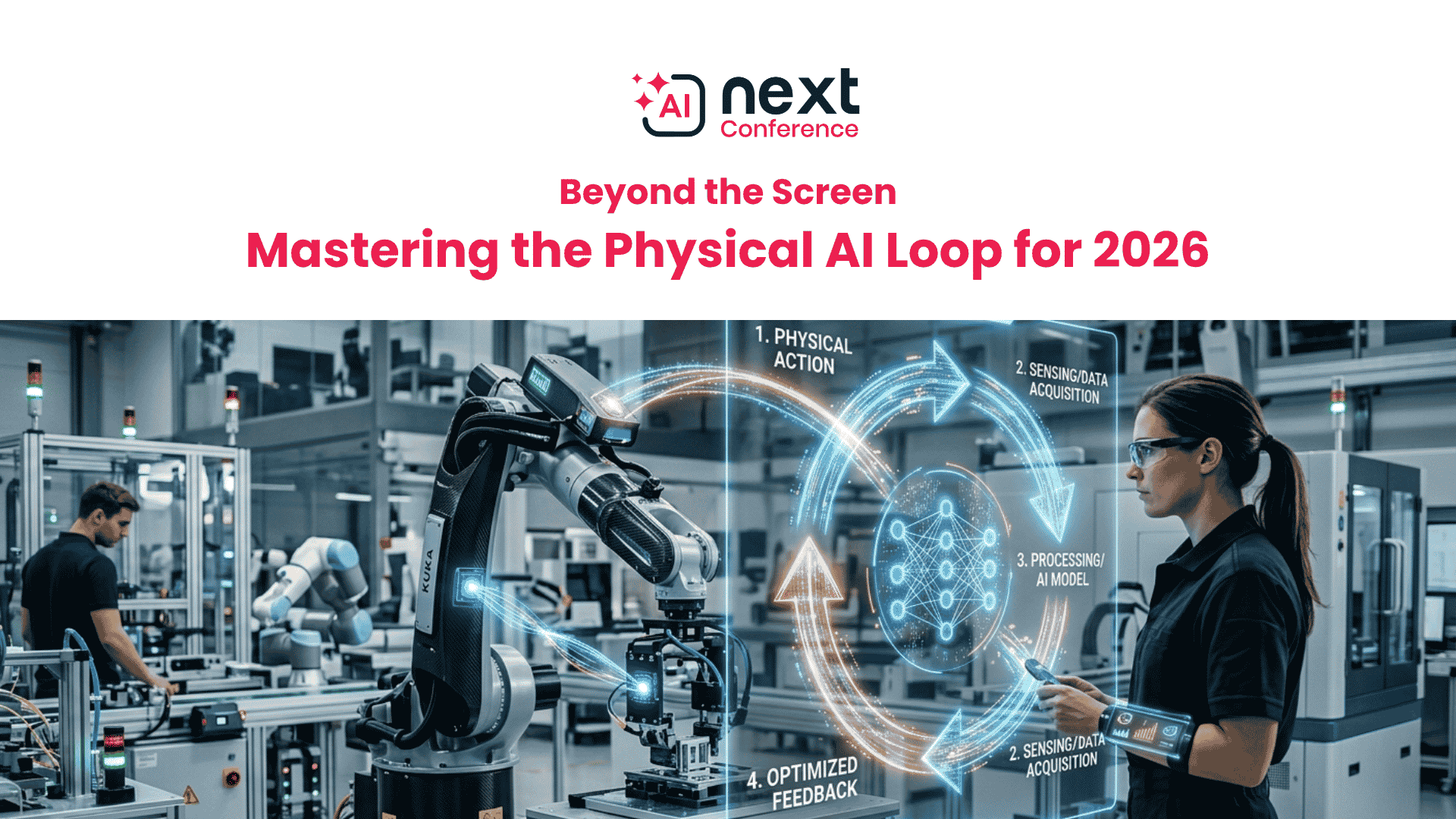
AI is no longer confined to the cloud—it's now acting in the physical world. Across factories, warehouses, and healthcare systems, we’ve entered the era of Physical AI, where intelligence doesn’t just advise; it executes.
What is the Physical AI Loop?
Unlike rigid automation, the Physical AI Loop is a continuous, self-improving cycle:
Sense: Multimodal sensors capture the messy reality of the physical world.
Reason: Onboard Vision-Language-Action (VLA) models process this data instantly at the edge.
Act: Systems adapt in real time to dynamic conditions
Learn: Every success and failure is fed back into a Digital Twin, refining the model for the next cycle .
This transforms machines from rule-followers into adaptive decision-makers.
Why This Is the Tipping Point
Several breakthroughs are making Physical AI scalable:
Edge Sovereignty: New neural processing units (NPUs) enable robots to make split-second, safety-critical decisions without waiting for a cloud signal .
The Sim-to-Real Bridge: High-fidelity simulations, such as NVIDIA Isaac, let robots to train virtually before real-world deployment
Collaborative Safety: Modern cobots use this loop to work safely alongside humans, slowing down or changing paths the moment a person enters their workspace .
What It Looks Like in Practice
Physical AI is already reshaping operations:
Zero-Touch Quality Control: Vision systems detect defects in motion, eliminating manual checks.
Humanoid Integration: Companies like Accenture and SAP are piloting humanoid robots for complex, non-repetitive tasks.
Self-Healing Supply Chains: Autonomous systems reroute logistics and adapt to disruptions in real time.
Anticipatory Shipping: AI predicts demand, optimizes routes, and improves inventory accuracy.
The Autonomous Orchestrator
While these loops transform individual factory floors, their true power emerges as an integrated Autonomous Orchestrator across global supply chains—turning unpredictable logistics into a self-healing ecosystem. Modern fulfillment centers are no longer just storage spaces; they’re intelligent ecosystems. Through the Physical AI Loop, systems like KNAPP’s Brain orchestrate fleets of Autonomous Mobile Robots (AMRs) using swarm intelligence to eliminate bottlenecks in real time.
Precision at the Point of Care: Healthcare in Action
Healthcare is a prime arena for Physical AI.
In Surgery:Closed-loop systems compensate for patient motion, delivering robotic tools with sub-millimeter precision.
Adaptive Rehabilitation: AI-powered prosthetics and exoskeletons adjust in real time to patient movement.
Ambient Monitoring: Smart beds and wearables detect anomalies before symptoms escalate.
The impact? Fewer complications, improved outcomes, and reduced clinician burnout—driven by execution, not experimentation.
The Bottom Line for Business
The companies winning in 2026 aren't just using AI to analyze their business; they're using it to run it. From autonomous prescription renewals in healthcare to zero-shot manufacturing where robots figure out tasks without programming, the Physical AI Loop is the new baseline for global competitiveness.
The evolution of the Physical AI Loop will take center stage at the AINext conference, where industry leaders will demonstrate how these integrated autonomous systems are redefining operational resilience. Join us to explore how your enterprise can transition from theoretical AI adoption to mastering real-world, agentic workflows that define the new industrial era.