
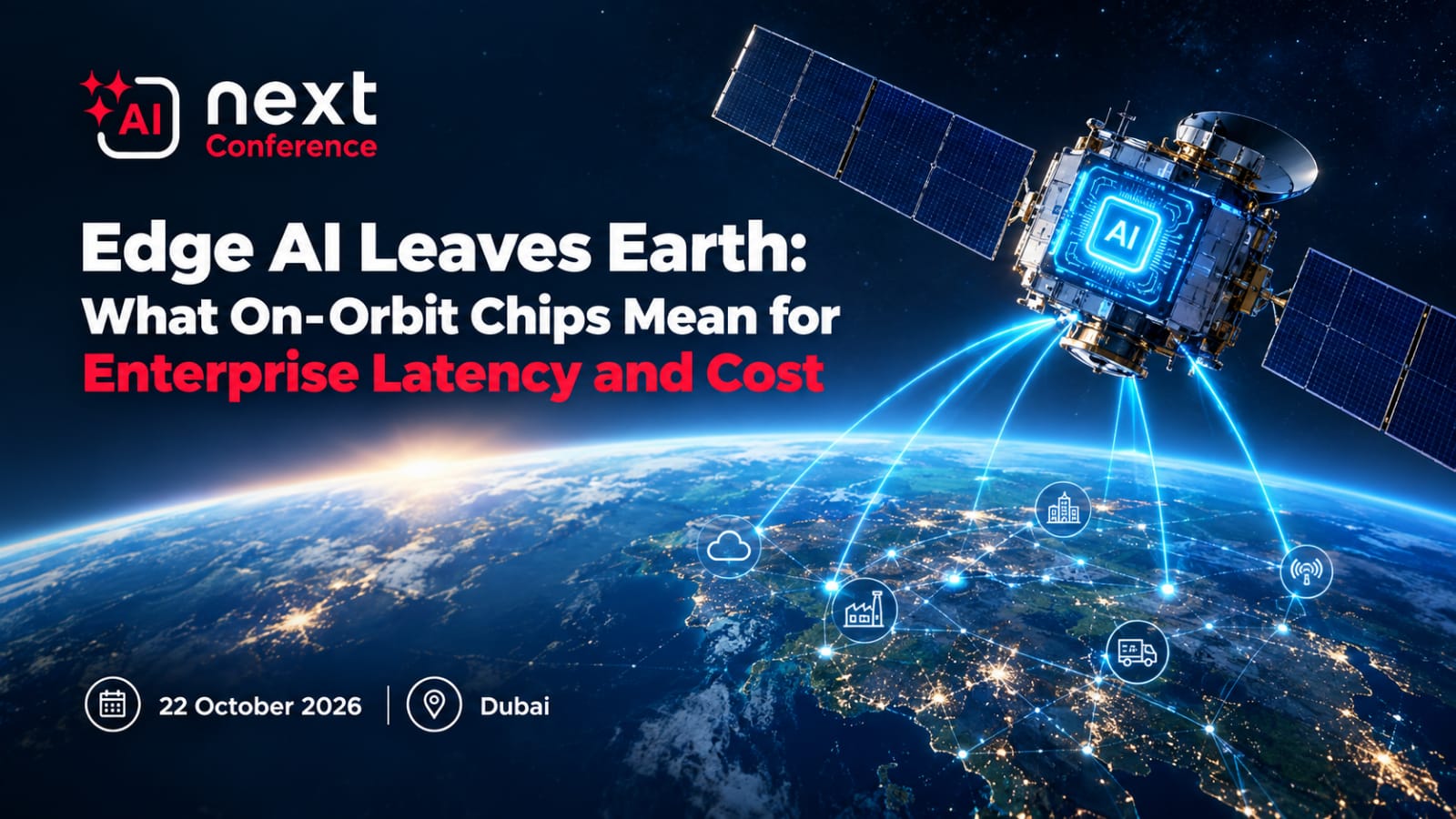
In October 2026, Google launched a prototype satellite carrying its custom Tensor Processing Units (TPUs) into low-Earth orbit. The mission, called Project Suncatcher, is an early test of whether machine-learning workloads can run efficiently in space using solar power. The goal is not just scientific curiosity. It is a strategic probe into a new layer of edge AI: compute that lives above the atmosphere and processes data before it reaches the ground.
For enterprise leaders, the relevance is clear. Today, satellites capture vast amounts of climate, agriculture, and geospatial data. Much of that data is downlinked to ground stations and then sent to cloud data centers for analysis. This pipeline can create latency, bandwidth requirements, and delays in time-critical decisions such as flood warnings, crop stress detection, or supply-chain monitoring. On-orbit AI changes that flow. If models run on the satellite, only insights, alerts, or selected data may need to be transmitted rather than entire datasets. That could reduce data-transfer requirements, shorten the time between data capture and action, and potentially lower downstream processing costs.
Google’s first orbital test is modest but telling. The refrigerator-sized prototype carries four TPUs and can run a version of the Gemma model in short periods because of thermal constraints. Engineers will study how the technology performs against the physical challenges of space, including radiation and extreme temperatures. Planned follow-on satellites in 2027 will test how multiple spacecraft can communicate through high-bandwidth laser links, an important step toward larger-scale orbital AI infrastructure.
This trajectory matters for enterprise AI strategy in three ways.
First, latency and autonomy. Edge AI on satellites could enable faster decisions for disaster response, precision agriculture, and maritime or energy-grid monitoring. Instead of waiting for ground-based processing, satellites could detect anomalies, classify events, and trigger alerts closer to the point where data is generated.
Second, bandwidth and cost. Downlinking every image or sensor reading can be expensive and inefficient. On-board inference can filter information and transmit only the data that matters. Across large fleets of sensors and satellites, this approach could reduce data-transfer requirements and the amount of information that must be processed downstream.
Third, resilience and scale. Space-based compute could eventually diversify where certain AI workloads run. As satellite networks become more capable, enterprises could explore orbital infrastructure for workloads where autonomous processing, remote operation, or reduced dependence on terrestrial connectivity provides a strategic advantage. However, these applications remain an emerging area of research rather than a mature enterprise-computing model.
The same logic applies closer to Earth. Screen-free edge AI on devices, wearables, vehicles, and industrial hardware follows the same pattern: push inference to the point of data creation, send only what matters to the cloud, and design systems that can respond in real time.
For CIOs and CTOs, the question is no longer simply whether edge AI will expand beyond the data center. It is which workloads should move first and where those workloads should be processed. Climate monitoring, logistics, energy, agriculture, and other data-intensive applications are natural candidates for distributed inference. Google’s orbital experiment is a signal that the edge is becoming three-dimensional—and that enterprise AI architectures may eventually need to account for compute across devices, terrestrial infrastructure, and space.
To explore how on-orbit and on-device edge AI could reshape latency, cost, and resilience for enterprise workloads, join the AINext Awards & Conference Dubai 2026 on 22 October at the Crowne Plaza Dubai – Deira. The one-day program brings together AI operators, researchers, and technology decision-makers to examine the infrastructure and technologies shaping the next generation of autonomous systems.
Register now to secure your place: ainextconference.com
Sources
Google Research — Project Suncatcher: prototype satellite and orbital AI infrastructure.
NPR — Google launches Project Suncatcher, a step towards AI data centres in space.